Open letter: Uneven distribution of UPC cases between the different Local/Regional/Central Divisions of the Court of First Instance
By
BARDEHLE PAGENBERG
To
EPLAW, Advisory Committee of the UPC, Public
Background
1 EPLAW asked us with e-mail of March 11, 2026, attaching an e-mail of March 2, 2026, from the chairperson of the Advisory Committee of the UPC to provide guidance relating to concerns about an uneven distribution of UPC cases between the different Local/Regional/Central Divisions of the Court of First Instance. EPLAW listed potential measures to be taken.
Executive summary
2 We do not necessarily share the concerns voiced and are – to the contrary – concerned that most of the measures listed by EPLAW would put the current success of the system at serious risk. These measures could encourage claimants to choose national litigation or litigation outside Europe instead, in case of need by adapting their patent prosecution strategies towards respective national patent rights.
3 The right question to be asked is rather whether there is a problem from the users’ perspective that needs to be solved. And the answer is in our view that there is no such problem. The uneven distribution of UPC cases between the different divisions merely is a consequence of market-driven dynamics reflecting a corresponding demand by a diverse user group including blue chips and SMEs alike. Throughout Europe, also prior to the start of the UPC, patent cases were unevenly distributed among national courts and jurisdictions.
4 Specifically, the high number of cases before the German local divisions and the local division The Hague is testament to the fact that user demand is actually met. These cases confirm the acceptance and the success of the overall system which exceeded expectations as of day one.
5 That said, we are well aware that the general acceptance of the system requires it to be a truly European system. Only in this case will other EU Member States join the system in the future and will the current Contracting Member States adhere to it. Therefore, it is meaningful to analyze whether the system can (further) be improved from the users’ perspective. And we believe it can. We are proposing expedient measures which are minimally invasive and thus designed to keep the system attractive for users. Any regulatory intervention inevitably entails risk and therefore requires careful consideration, mindfulness and in any event a balanced and moderate approach based on data rather than emotions or speculations.
6 We believe to be well positioned to provide guidance, given that we are a European IP only law firm founded in 1977 with offices in Germany, France and Spain comprising about 100 attorneys-at-law and patent attorneys wherein patent litigation is part of our DNA. We were involved in about a third of the UPC proceedings filed on June 1, 2023, and still today we are involved in about a quarter of all UPC proceedings filed since then. We represent claimants and defendants at about an equal share. We have appeared in ten different divisions of the Court of First Instance including all central divisions and before all panels of the Court of Appeal. Externally, we were and still are deeply involved in establishing and promoting the system at national and international conferences, through active participation in bench and bar meetings of various divisions, through mock trials as well as peer-reviewed articles and other scholarly work. Internally, we strongly invested and trained ourselves as well as our clients intensely for years before the system actually started. This is one of the reasons why our clients asked us to actually use the UPC and represent their interests there. While about 50% of our patent activity is litigation, the other about 50% is prosecution. Many of our clients holding patents opt for hybrid litigation strategies, that is UPC as well as parallel national litigation. Given that the initial transitional period will end as early as 2030, many of our clients trim their portfolios already today to include national patent rights to still have the option to enforce at the national level.
Reasons for the current state of play
7 To date, the system undoubtedly is a success story. The UPC exceeded expectations in terms of user acceptance and caseload by far. Steadily increasing case numbers, global user acceptance, and several rounds of additional hires of legally as well as technically qualified judges within the first 2.5 years are testament to that.
User demand and expectations
8 What are the underlying reasons? From our experience gained in our actual UPC work, and many discussions with clients, potential users, judges and peers, we believe that the broad acceptance by users is deeply rooted in the quality, speed, flexibility, reliability, and predictability of adjudication that the UPC offers at reasonable costs.
9 The early users specifically appreciated that certain judges engaged early and were vocal in how they intend to do things, creating trust and procedural predictability even before the system started. For this reason, the early users brought their cases to these judges. They were pleased with the quality, speed, and flexibility they encountered and spread the word. Some were particularly impressed to receive written and/or oral preliminary opinions from the bench, allowing them (contingency) planning and risk mitigation, which is key from a business perspective and often leads to early settlements.
10 In our experience, “patentee-friendliness” is not the driving factor. This is confirmed by actual data. We collect data on win rates for all divisions and cases. The win rates at the most frequented divisions are in the same order compared with those at other divisions. There is not a single division with substantially higher win rates, while there are a few with much lower win rates but based on a relatively small sample size. And of course, there is a common Court of Appeal with tools available to immediately lift or suspend any decision or order not correctly applying the law on the given facts.
Designed as a Freedom-of-Choice system
11 Users also trust the system because it is – by its very design – an open system deliberately giving claimants the freedom of choice to select their preferred forum out of a comparably large number of available fora.
12 This flexible and open design somewhat mirrors fundamental freedoms of the Internal Market.
13 It has been further strengthened by the case law of the Court of First Instance and the Court of Appeal with regard to accepting broad international and local jurisdiction in a variety of cross-border case scenarios.
14 A trend that is fueled by and in line with the case law of the Court of Justice of the European Union, most recently the BSH v Electrolux decision.
15 However, this case law likewise grants broad jurisdiction to national courts, allowing in many cases to centralize European patent litigation there. Claimants thus have the choice to select their preferred forum on this level as well, which should be considered when contemplating regulatory intervention.
Historical background
16 The current distribution of cases also has historical reasons. The vast majority of European patent litigation cases were brought in Germany even before the start of the UPC, creating a wealth of experience, including but not limited to SEP cases which form a sizable portion of the UPC’s work. According to Juve Patent data, prior to the start of the UPC, about 600 to 800 patent infringement cases were filed in Germany every year, which is about four to five times as much as the number of cases in France, Italy or the Netherlands.
17 It will therefore not be a coincidence that the majority of legally as well as technically qualified UPC judges appointed initially and with consecutive hires have a German background including SEP expertise.
Limited choice due to validation strategies
18 The current distribution of cases also reflects the fact that nearly 90% of all pending European bundle patents are validated in Germany with only France being close. Even in Italy and the Netherlands, only around 50% or less of European patents are validated. Therefore, in many potential cases, only the German and French local divisions can have jurisdiction from the outset.
19 The Unitary Patent will change this situation with a promising global up-take rate of over 30% and an EU uptake rate of 42,8% (Statistics & Trends Centre | epo.org), yet, this will still take time.
Origin of plaintiffs and defendants
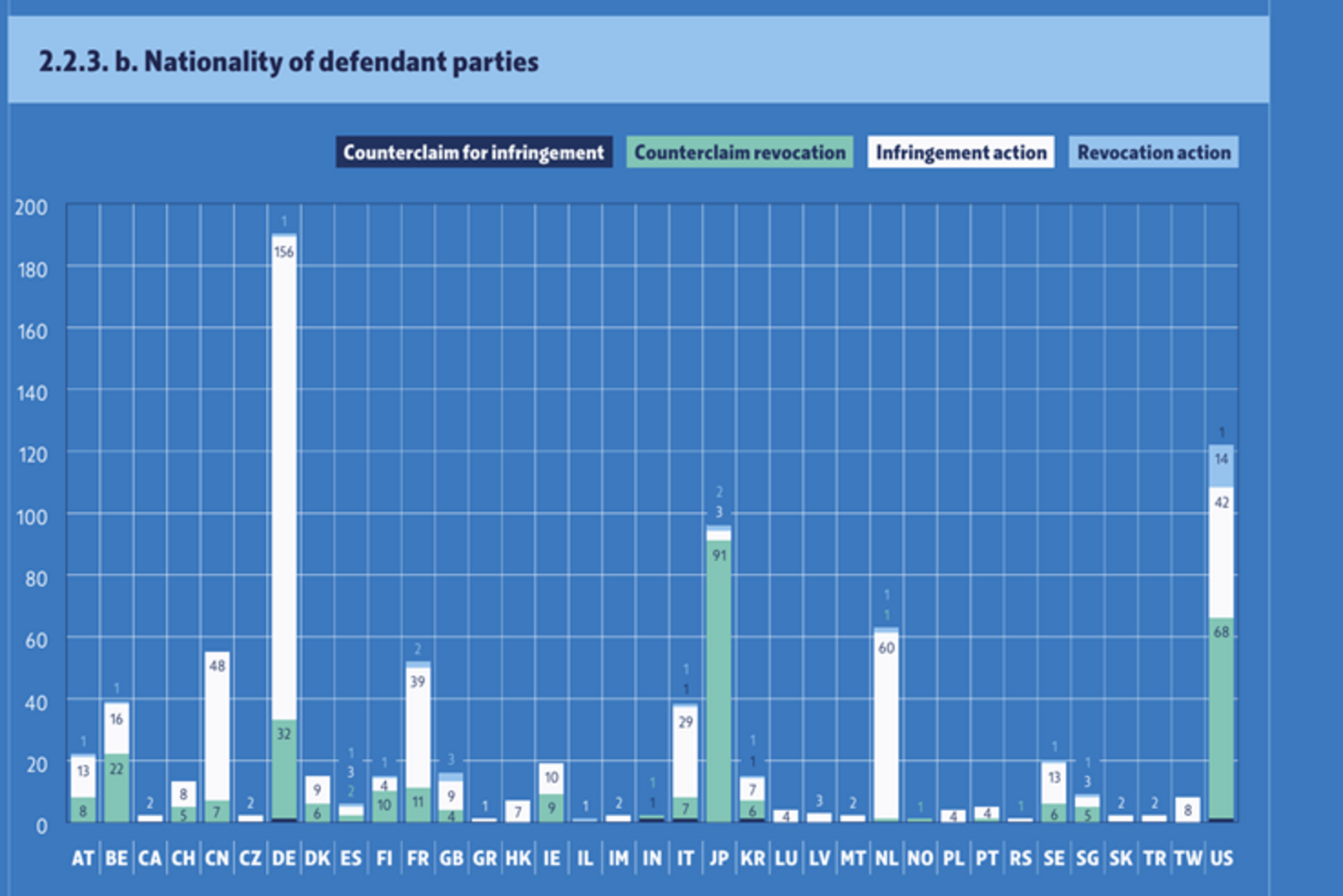
20 German companies are by far the most prevalent defendants. It is only natural that they are sued at their domicile which is in line with the principles of jurisdiction according to the Brussels Recast Regulation:
Source: UPC
21 Similarly, German companies are very active as plaintiffs.

Source: UPC
Trusted relationships
22 Many claimants have long-standing, direct relationships with certain law firms established over decades and reinforced through a proven track record. Likewise, claimants advised by these law firms select the judges they know and trust from earlier cases.
23 The current uneven distribution of UPC cases between the different divisions could thus be seen as a legitimate desire for continuity from the users’ perspective.
24 It is for market participants and not for the regulator to actively try to change such desire by embracing competition. And it is for the regulator to ensure that competition takes place freely.
Measures
25 In view of these facts and reasons, any contemplated measure should be pressure-tested against the above-described analysis and must be user-centric. To date, the UPC has – despite still being a young system with many open questions – attracted litigants and their trust by providing effective legal protection and reliable risk management through the pioneering work of the most frequented judges.
26 We believe it to be paramount to keep the system attractive for innovators seeking effective legal protection in Europe and for users seeking freedom to operate. Their demand and expectations should be kept at the heart of any regulatory intervention. Any artificial redistribution of cases could be counter-productive and might trigger a migration of cases to national courts or even to jurisdictions outside Europe. The former goes against the interest of EU-wide patent protection and enforcement. The latter might be harmful to the European industry if there is an increasing need for European innovators to seek enforcement in non-European countries or for European companies to defend themselves against patent assertions in such jurisdictions.
27 Therefore, first and foremost, the system should remain a freedom-of-choice system ensuring open competition, and it should be up to the users to make the right choices.
28 We therefore and for the further reasons listed hereinafter oppose the following measures contemplated by EPLAW:
- “Not having more than one panel of judges per division in Contracting Members States (in general or only where there are already more than one or the maximum of four Local Divisions). This might lead to longer lead-times in these divisions if the current concentration is maintained, thereby providing incentive to choose a different Division.”
This measure would artificially limit the users’ choices.
- “Offering the parties a transfer to another local or regional division if it is likely that the case would not be decided within a given timeline (e.g. 18 months).”
This measure is unrealistic to succeed because at least one party is usually interested in a delay and will thus oppose a transfer.
- “Allowing the UPC (e.g. the President of the CFI) to mandatorily distribute new cases, or redistribute cases, depending on caseload.”
- “Changing the allocation of judges from the international pool to cases in any given division, so for example either limiting the ‘local’ judge representation to one member of the panel for all divisions, or even abolishing the role of ‘local’ judges completely so that all panels are drawn from the international pool regardless of locale (again this would require changes to the legislative framework).”
These measures would contravene or limit the users’ choices. They would impair predictability and reliability and make risk management more difficult.
29 In contrast, we have no concerns with respect to and partly welcome the following measures contemplated by EPLAW:
- “Allow Declarations of Non-Infringement to be filed in Local Divisions instead of Central Divisions. This would require a change of the UPCA.”
We are neutral on this proposal. In our view, the measure will not hurt but also will not change much. Declarations of non-infringement are and will remain rare in practice.
- “Changing the allocation of judges in that e.g. German judges spend more time at a non-German Division and/or having non-German judges being more permanently allocated to a German Division.”
We welcome this measure. It would allow for a better sharing of experience and training among judges. It would strengthen predictability and reliability for users. It would create a truly European team effort.
30 We propose the following additional measures which are partly already applied by certain divisions:
- Use an international judge as the judge rapporteur in suitable cases to better share experiences, provide training and possibly standardize the application of the procedural framework (e.g. by uniformly providing preliminary opinions).
- Continue to allow judges to broadly use suitable fora to present their views and style and to make themselves known among the global community. The Presidents of the Court of First Instance and of the Court of Appeal should encourage all UPC judges to play an active role and to accept corresponding invitations to speak on such occasions.
31 Summing up, a more even distribution of UPC cases between the different divisions can be best achieved by improving trust and predictability across all divisions. A continuation of the uptake rate of the Unitary Patent will add to that as will natural shifts of work which are best known from and a reality in German national practice. And even if a certain level of unevenness would remain, that would not be a problem.
Prof. Dr. Tilman Müller-Stoy, UPC Representative
on behalf of
BARDEHLE PAGENBERG
Date
Author
Tilman Müller-Stoy
Attorney-at-Law (Rechtsanwalt), Certified IP lawyer, Commercial Mediator (MuCDR), UPC Representative, Partner