Lego’s recent loss before the EGC: A reminder of the four-stage assessment of a design’s individual character (T-628/42)


In its seminal decision dated January 14, 2026, regarding one of Lego’s numerous registered building block EU designs, the General Court of the EU upheld the decision of the lower Board of Appeal (September 25, 2024, R 162/2023-3), overall confirming that Lego’s design registration lacks individual character. In doing so, the Court provided useful guidance on the assessment of individual character with respect to design registrations filed on behalf of Lego A/S (to the best of our knowledge, this is the first time that the General Court had to assess individual character of a Lego design registration).

As a formal remark, while Regulation (EU) 2024/2822 as of May 1, 2025, replaced the title of “Council Regulation (EC) No 6/2002 on Community designs” by “Council Regulation (EC) No 6/2002 on European Union designs” and, thus, the notion “Community design” by “European Union design” (or “EU design”), the provisions for establishing protection of an EU design, including the requirement of novelty (Art. 5 EUDR) and individual character (Art. 6 EUDR), remained unchanged.


1. Previous instances


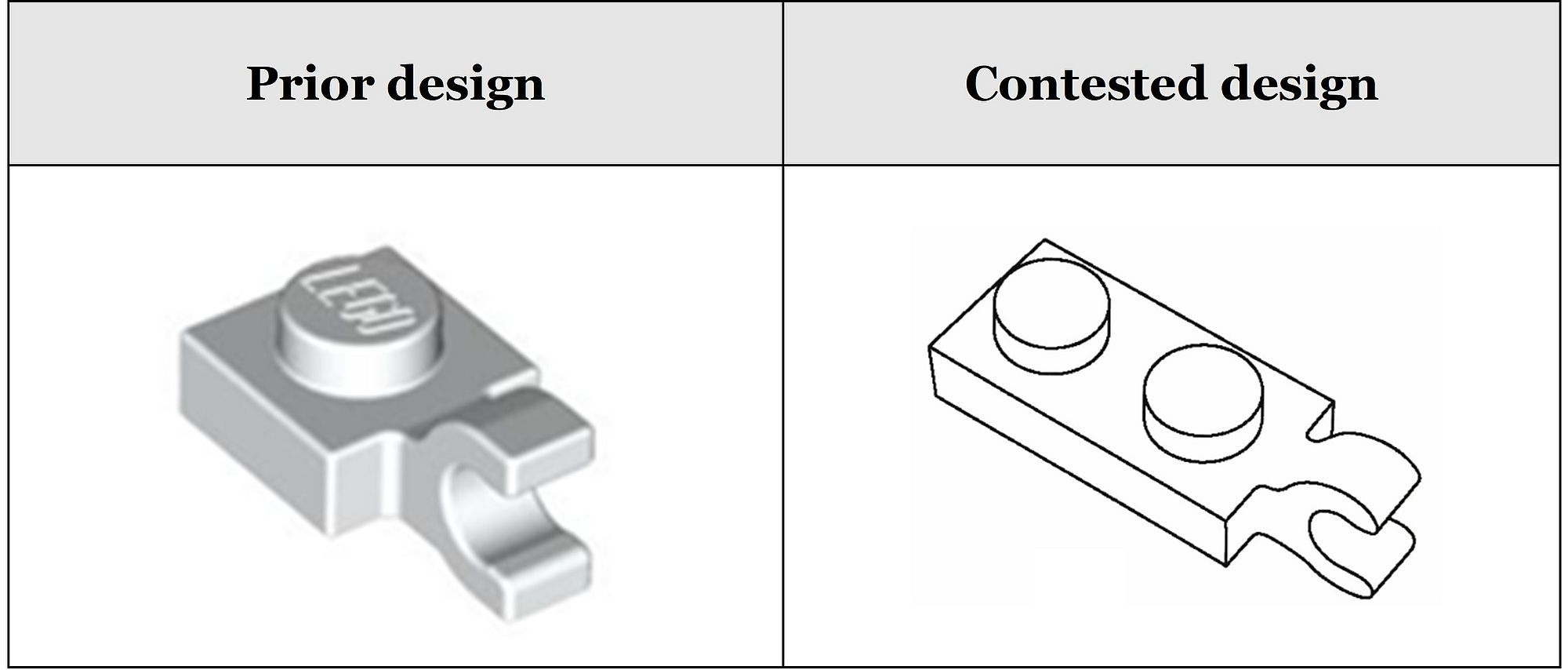
The design in dispute, REUD no. 001050645-0003, was registered by the EUIPO on November 28, 2008, on behalf of Lego A/S (in the following “contested design”). On March 31, 2021, Guangdong Qman Toys Industry Co., Ltd. (in the following: “Qman Toys”) brought a request for a declaration of invalidity regarding the contested design with the EUIPO. Qman Toys claimed that the design lacked individual character based on an earlier Lego building block (in the following: “prior design”; Arts. 25 (1)(b), 6 EUDR):  


On November 28, 2022, the EUIPO’s Invalidity Division declared the contested design invalid because of its lack of individual character. The EUIPO’s Board of Appeal reached the same conclusion with its decision dated September 25, 2024 (in the following: “contested decision”). According to the Board of Appeal, both designs coincided in their main features, namely a plate with a cylindrical solid stud on the upper side, smooth surfaces, and a crescent-shaped clamp placed at the center of and perpendicular to one of the outer walls.

With its action for annulment (Art. 263 TFEU), Lego claimed that the Board of Appeal erred in its finding of a similar overall impression because it did not sufficiently take into account the outer rectangular shape and overall configuration of the designs including the second stud of the contested design (C.I.) and the underside of those designs with the central cylindrical element of the contested design (C.II.).


2. Decision of the General Court


However, Lego’s line of argument did not succeed, and the General Court dismissed Lego’s action, stating that the presented differences were not sufficient to create a different overall impression on the informed user.

Before evaluating the overall impression, as a first step, the sector to which the products in which the contested design is intended to be incorporated must be determined. Here, the relevant sector is a toy building set with building blocks.
The second step is the determination of the informed user, a fictional person who can only be defined in general terms with regard to the products in which the contested design will be incorporated. In the present case, the informed user is whoever habitually purchases such items, puts them to their intended use, possesses a certain degree of knowledge with regard to the features that those designs normally include, and shows a relatively high level of attention.

As a subsequent third step, the designer’s degree of freedom needs to be determined, as this is decisive in determining how great the differences must be in order to create a different overall impression. In the present case, on the one hand, it was common ground between the parties that the degree of freedom of the designer of the contested design is limited by the interoperability requirement, which means that the blocks from a toy building set must be capable of connecting with one another. On the other hand, the General Court stated that this interoperability requirement between the blocks does not limit their general appearance because not all features are solely dictated by their technical function. The multitude of design options becomes clear in view of the illustrations reproduced in the contested decision (para. 35):


The General Court therefore concluded that the designer had considerable freedom in developing the contested design with the consequence that minor differences between the designs at issue would not be sufficient to produce a different overall impression on an informed user.

The standards for the assessment of the overall impression are determined by settled case law. According to that, the individual character of a design results from an overall impression of difference or lack of déjà vu, from the point of view of an informed user. Thereby, insufficiently significant details that do not affect the overall impression should not be considered. Additionally, it is important that the comparison of the designs needs to be synthetic and may not be limited to an analytic comparison of a list of similarities and differences.

Subsequently, the General Court applied these established standards to evaluate the differences presented in the designs at issue.

2.1 Outer shape with second stud

The General Court started by clarifying that besides its technical function, the second stud needs to be taken into account because the exception of Art. 8 (3) EUDR is applicable. This norm, which is also called ‘Lego clause’, provides that features of appearance that serve the purpose of enabling the assembly or connection of a variety of interchangeable products within a modular system are protectable despite their technical character.  

However, the Court concluded that when two squares are combined during construction, they naturally form a rectangle. Consequently, the informed user will be able to perceive the contested design as a continuation of the same pattern established in the prior design. Therefore, the informed user will not pay particular attention to the difference in shape and number of similar studs of the blocks.

2.2 Underside with cylindrical element

To Lego’s disadvantage, the same applied to the underside of the contested design, which had a central cylindrical element that was missing in the prior design:


In that respect, the decisive factor for the General Court was the manner in which the blocks are normally used and handled. The Court stated that when the blocks are used, the underside remains hidden most of the time. Although it may be visible for a short time, it is definitely hidden once interlocked with other building blocks. Therefore, the upper side remained exposed for longer than the underside and was consequently decisive. Lego’s argument that the cylindrical element served to reinforce the attachment system was countered with the Court’s assessment that it is not the perception of a user who is a specialist in the field and who has detailed technical expertise, which is decisive. Finally, the Court agreed with the Board of Appeal in its assessment that the underside of the designs also reveals similarities, such as a wide rim and circular elements corresponding to the studs on the top.

Consequently, as the different features that were visible in an analytic comparison were not decisive for a synthetic comparison, the designs at issue did not create a different overall impression on the informed user. Lego’s action was therefore dismissed (para. 85).


3. Analysis and future prospects


The General Court’s decision attracted some attention, be it because many people are Lego enthusiasts or because it provides important guidance for the assessment of the overall impression when determining the individual character of a design.

In summary, this decision is in line with established legal standards. As the General Court explained at the beginning of its decision (para. 22), the assessment of the individual character needs to be carried out in four stages:

  1. Determination of the sector in which the products to which the contested design is intended to be applied belong
  2. Definition of the informed user
  3. Determination of the designer’s degree of freedom
  4. Comparison of the overall impressions

The decision shows how the existing differences between the designs at issue become less significant when the four-step assessment is carried out sequentially. It also highlights the following two points. First, the importance of the determination of the designer’s degree of freedom and, second, the standard that the comparison of the overall impression needs to be carried out synthetically and not in an analytical way.

The General Court already established in 2011 a sort of interaction between the designer’s degree of freedom and the quality of differences that must be identified in order to ascertain a different overall impression. In its decision Kwang Yang v Honda (T-11/08; para. 33), the Court stated (emphasis added) that “if the designer enjoys a high degree of freedom in developing a design, that reinforces the conclusion that the designs which do not have significant differences produce the same overall impression on an informed user.”

Following these standards, the General Court’s decision in the Lego case is comprehensible. For Lego’s contested design, the designer’s degree of freedom was considerable and, consequently, significant differences over the prior design were required for finding a different overall impression.

Furthermore, the decision also corresponds to the purpose and intent of Art. 6 EUDR, allowing protection for designs, with a monopoly for 25 years maximum, only if they have their individual character in the sense of their own character.

Finally, the Court’s decision is also in line with other case law according to which color, material, trademarks, etc. shown in the prior design but not in the contested design must be ignored. The same is true when ignoring proportions, dimensions, or diameters as a claimed feature of difference (particularly T-9/15 and R 1408/2012-3).

That said, and given that various pending EUIPO proceedings related to Lego design registrations have been suspended in view of T-628/24 (for instance, R 182/2023-3, R 160/2023-3, R 2129/2022-3, and R 507/2024-3), it is likely that we will see more Lego building block design registrations come under pressure.
Date


Author

Lisa Lilge
Attorney-at-Law (Rechtsanwältin)

Lisa Lilge