Author Archive

EUROPEAN SOFTWARE PATENTS March 2019 updates

March came with seven new decisions in the EUROPEAN SOFTWARE PATENTS knowledge base relating to artificial intelligence, computer simulations, information modelling and Internet search engines:

Software patents for artificial intelligence?

Artificial intelligence is undoubtedly one of the hottest topics in tech these days. So far, there are only few decisions of the EPO Boards of Appeal dealing specifically with AI.

But some questions have been decided already: According to one Board, the question whether two text documents belong to the same class of documents in respect of their textual content is non-technical. Similarly, classifying data records for a non-technical purpose (e.g. for billing) was considered to be a non-technical issue.

(more…)

Simulating pedestrian crowd movement: to be decided by the Enlarged Board of Appeal

The Technical Board of Appeal 3.5.07 is uncertain whether a method of modelling pedestrian crowd movement in an environment and using the results for designing a building structure is technical or not. Here are the practical takeaways from the decision T 0489/14 (Pedestrian simulation/CONNOR) of 22.2.2019:

Key takeaways

According to earlier case law referring to the simulation of an electronic circuit, a computer-implemented method has technical character if the method is functionally limited to a technical purpose. However, in the present decision, the Technical Board of Appeal is uncertain whether the earlier reasoning is correct since the claimed subject-matter allegedly lacks a link to the physical reality.

Hence, the Board formulated three referral questions to the Enlarged Board of Appeal (the highest judicial entity in the European patent system) asking it to decide essentially whether the simulation of a technical system has to be excluded from patent protection or not.

The invention

The patent application underlying this case concerns the modelling of pedestrian movement, which could be used to help design or modify a venue (building structures like houses or train stations). According to the applicant, this provides a more accurate and realistic simulation of pedestrian crowds in real-world situations, which could not be adequately modelled by conventional simulators. The invention is said to be based on the insight that human interaction could be expressed and modelled in the same way as physical interactions.

Fig. 2 of WO 22004/023347 A2

  • Claim 1 (main request)

  • Claim 1 (auxiliary request IV)

Is it patentable?

The EPO’s first instance examining division rejected the patent application by arguing that a simulation model is non-technical and that its implementation on a computer is obvious. In the appeal, the applicant argued in a nutshell that the method steps referring to the simulation algorithm are indeed technical because they relate to physical parameters (“humans cannot walk through a wall”). Moreover, the simulation according to the invention would have multiple similarities to the simulation of an electronic circuit which was considered technical in T 1227/05:

The application concerned modelling pedestrian movement, which could be used to help design or modify a venue. It sought a more accurate and realistic simulation of pedestrian crowds in real-world situations, which could not be adequately modelled by conventional simulators. The application was based, at least in part, on the insight that human interaction could be expressed and modelled in the same way as physical interactions.

In claim 1 of the main request, which was now directed to a method of modelling pedestrian crowd movement in an environment by means of simulation, the method steps contributed to the technical character of the invention in two ways. First, the method steps were themselves technical features, as they related to physical parameters which could be expressed in terms of physical quantities and involved applying physical laws of motion and considerations of cost or work. Second, they contributed to the technical character of the invention by virtue of their interaction with the computer. The method of claim 1 produced a technical effect in the form of a more accurate simulation of crowd movement. Following decision T 1227/05, modelling pedestrian crowd movement in an environment constituted an adequately defined technical purpose for a computer-implemented method. The claimed method yielded accurate and repeatable results no different from those produced by a method of modelling an electron using a similar numerical method. Moreover, the claimed simulation method was no more suited to being carried out mentally than the simulation method considered in decision T 1227/05.

According to the applicant, particularly claim 1 of auxiliary request IV would help clarify that a technical effect outside the computer is produced:

The third, fourth and fifth auxiliary requests helped clarify the effect outside the computer and emphasised that the process was one which could not be performed simply with the help of pencil and paper.

The board in case T 1227/05 had adopted a correct approach. It had recognised the importance of simulations and had understood the practical issues in claiming them. This approach had been followed in decision T 625/11 of 19 January 2017.

How the EPO examines software patentsBy the way, if you are interested in a deeper look into how the European Patent Office examines software-related inventions, this 30-minute video gives a concise overview of the “two hurdle” approach with lots of examples.

However, the Board in charge of this appeal expresses concerns about the correctness of T 1227/05 and raises doubts whether the invention underlying T 1227/05 produces a technical effect sufficient to constitute patent-eligibility:

11. In the Board’s view, a technical effect requires, at a minimum, a direct link with physical reality, such as a change in or a measurement of a physical entity. Such a link is not present where, for example, the parabolic trajectory followed by a hypothetical object under the influence of gravity is calculated. Nor can the Board detect such a direct link in the process of calculating the trajectories of hypothetical pedestrians as they move through a modelled environment, which is what is claimed here. In fact, the environment being modelled may not exist and may never exist. And the simulation could be run to support purely theoretical scientific investigations, or it could be used to simulate the movement of pedestrians through the virtual world of a video game.

15. In sum, the Board agrees with the appellant that decision T 1227/05 supports his case. However, the Board is not fully convinced by the decision’s reasoning. Its doubts are twofold.

First, although a computer-implemented simulation of a circuit or environment is a tool that can perform a function “typical of modern engineering work”, it assists the engineer only in the cognitive process of verifying the design of the circuit or environment, i.e. of studying the behaviour of the virtual circuit or environment designed. The circuit or environment, when realised, may be a technical object, but the cognitive process of theoretically verifying its design appears to be fundamentally non-technical.

Second, the decision [editor’s note: T 1227/05] appears to rely on the greater speed of the computer-implemented method as an argument for finding technicality. But any algorithmically specified procedure that can be carried out mentally can be carried out more quickly if implemented on a computer, and it is not the case that the implementation of a non-technical method on a computer necessarily results in a process providing a technical contribution going beyond its computer implementation (see e.g. decision T 1670/07 of 11 July 2013, reasons 9).

The Board applies the same line of argumentation with respect to claim 1 of the fourth auxiliary request, which explicitly relates to a process for designing a building structure:

This amendment limits the claimed computer-implemented simulation to its use in a method of design. Since decision T 1227/05 essentially derives the technicality of a computer-implemented simulation from its significance for modern product development processes, this limitation arguably strengthens the appellant’s case. The amendment does not, however, change the Board’s present position that the claimed computer-implemented simulation does not contribute to a technical effect, as a direct link with physical reality is still absent.

Further, the Board recognizes the (economic) importance of computer-implemented numerical simulations, but is hesitant to base its decision on such considerations:

There is no doubt that the significance of numerical development tools has increased even more since case T 1227/05 was decided, yet the Board is hesitant to base its decision on policy considerations relating to the appropriate scope of patent protection that have not been expressed by the legislator and have in fact arisen only since the relevant provisions of the EPC were enacted (the Diplomatic Conference for the revision of the EPC in 2000 not having materially changed them). The Board is aware that the legislator deliberately refrained from defining the terms “technical” and “technology” in order not to preclude adequate protection being available for the results of future developments in fields of research which the legislator could not foresee (cf. decision G 2/07, reasons 6.4.2.1), but it sees a difference between the emergence of a new field of innovation and a change in the perceived significance of an existing field.

As a result, the Technical Board of Appeal formulated three questions to be referred to the Enlarged Board of Appeal and consequently postponed the decision:

“In the assessment of inventive step, can the computer-implemented simulation of a technical system or process solve a technical problem by producing a technical effect which goes beyond the simulation’s implementation on a computer, if the computer-implemented simulation is claimed as such?”

“If the answer to the first question is yes, what are the relevant criteria for assessing whether a computer-implemented simulation claimed as such solves a technical problem? In particular, is it a sufficient condition that the simulation is based, at least in part, on technical principles underlying the simulated system or process?”

“What are the answers to the first and second questions if the computer-implemented simulation is claimed as part of a design process, in particular for verifying a design?”

More information

You can read the whole decision here: T 0489/14 (Pedestrian simulation/CONNOR) of 22.2.2019.

This case has also been discussed on The IPKat, the Kluwer Patent Blog and Lexology.

Improving Internet search results: probably technical if reliably achieved

The European Patent Office refused to grant a software patent for an Internet search engine that improves the quality of the search results. Here are the practical takeaways from the decision T 1849/17 (Search engine with user feedback/PINTEREST) of 12.2.2019 of Technical Board of Appeal 3.5.06:

Key takeaways

Producing relevant search results quicker (or higher up on the list of results) and thus reducing the time until a user finds a “hit” in the search results may be a technical effect (left open in this decision).

The invention

The application relates to Internet search engines and concerns the problem of improving the perceived quality of the search results. More specifically, the application addresses the problem of making search results more “relevant” for the user. In prior art solutions, discussed in the application, the relevance of a document was assessed on the basis of the content of that document, of links between web pages or the feedback of test users. The invention essentially proposes to allow direct relevance feedback by users on individual results returned in response to a query.

Fig. 2 of EP 1 866 738

The application proposes modeling the “probability” that a given document is relevant by “logistic regression” based on features of the document such as binary values each indicating the presence or absence of a feature) and “parameters” theta (effectively weights). This model is modified in view of the user feedback, especially the weighted parameter psiu per user u. Users’ feedback may be clustered, for instance in view of groups of users, or in order to detect and exclude search engine optimizers and spammers as outliers due to the “eccentricities in their parameters”. Additional parameters gammac determined per cluster c may be used to adapt the relevance model.

  • Claim 1 (main request)

Is it patentable?

First of all, the Board did not follow the applicant’s argument that the invention results in a faster and more efficient execution of a search:

The appellant argued that the claimed invention provided a “faster and more efficient execution of a search” and a “faster and more efficient ranking” of search results “on a computer”, which had to be considered as technical problems. In particular, the features of “discarding” previous user feedback (see claim 1, step a, last phrase) and that of eliminating “bias” by reference to a “group model” contributed to these effects (see the grounds of appeal, page 2, paragraph 5, and page 5, paragraph 2).

The board does not accept that the search itself executes any “faster” or “more efficient[ly]” due to the claimed relevance feedback, in particular because the search results are ranked after retrieval. Likewise, the ranking itself cannot be said to be determined any “faster” or “more efficient[ly]”, inter alia because the reference for this comparison is not indicated (“faster and more efficient” than what?).

On the one hand, the Board did not rule out that reducing the time until the user finds a hit in the search results may probably be considered technical. However, the Board did ultimately not decide on this question since the effect was found not to be reliably achieved:

Generally speaking, the invention is meant to produce relevant search results quicker (or higher up on the list of results) and thus to reduce the time until a user finds a “hit” in the search results. A relevance feedback that would reliably achieve this effect might save the user certain work, such as clicking through a long list of search results or having to repeat a search. The board does not wish to exclude the possibility that this may be considered as a technical effect by analogy to the ratio of T 0643/00, which is that providing a technical tool for efficient search, retrieval and evaluation of images may be considered a technical problem solved.

This issue need not be decided, however, because it cannot be established that the invention does indeed reliably and reproducibly have the alleged effect. Without knowing any details about how the relevance models are computed from (or based on) the user feedback and how the groups are determined, there is no basis for assessing even the probability that – or in which situations – the relevance feedback would actually be pertinent for an individual user.

The board therefore concludes that the claimed invention cannot be said to have the effect of saving the user work in the above-mentioned sense.

Another feature of the invention was that a previous user rating can be discarded. But also this did not convince the Board:

Likewise, it cannot be established that discarding a previous user rating has this effect. For instance, it is not guaranteed that the last user feedback on a particular document is relevant for the next search. The user might, for instance, in one instance search for holiday destinations and rate highly a document mentioning the country Turkey, and in the next instance look for Thanksgiving recipes and be interested in documents mentioning turkey, the bird.

Thus, the Board took the view that the mathematical model used to determine the relevance of the search results was just a mathematical method as such:

Hence, the board must conclude that the relevance formula (in step c of claim of the main request and auxiliary request 1 or step g of auxiliary 2) is just any mathematical formula – and, as such, excluded from patentability by analogy to the exclusion of Article 52(2)(a) and (3) EPC 1973 – which does not contribute to the technical character of the claimed invention and, therefore, cannot contribute to inventive step (see T 641/00, headnote 1).

Therefore, the Board ultimately decided that the patent application does not provide any technical contribution that could be the basis for an inventive step.

More information

You can read the whole decision here: T 1849/17 (Search engine with user feedback/PINTEREST) of 12.2.2019

Information modelling as such: non-technical

The European Patent Office refused to grant a software patent for analysing a physical system and providing an information model reflecting its properties. Here are the practical takeaways from the decision T 0049/99 (Information modelling/INTERNATIONAL COMPUTERS) of 5.3.2002 of Technical Board of Appeal 3.5.01:

Key takeaways

Catchword: “Information modelling is an intellectual activity and should be treated like any other human activity in a non-technical field, which is, as such, not an invention for the purposes of Article 52(1) EPC. Only the purposive use of information modelling in the context of a solution to a technical problem may contribute to the technical character of an invention.”

The invention

This European patent application essentially concerned a method for modelling a physical system in terms of abstract objects representing physical elements of the system and relationships between the objects. The preferred embodiment of the invention aimed at providing a single, comprehensive description of the equipment in a power system, including network topology, operational constraints and limits, telemetry and communication details. The claims, however, were not restricted to the specific power system.

Fig. 1 of EP 0 658 260

  • Claim 1 (main request)

Is it patentable?

Claim 1 mainly concerned a method for analysing a physical system and providing an information model reflecting the essential properties of the physical system. Information modelling, however, was considered to be an intellectual activity and thus non-technical by the Board:

Information modelling is a formalized process carried out by a system engineer or a similar skilled person in a first stage of software development for systematically gathering data about the physical system to be modelled or simulated and to provide so to say a real world model of the system on paper. Although information modelling embodies useful concepts and methods in developing complex software systems, it is as such an intellectual activity having all traits typical for non-technical branches of knowledge and thus being closely analogous to the non-inventions listed under Article 52(2)(a) and (c) EPC.

Interestingly though, the Board noted that the situation might be different if information modelling was used “purposively” for solving a technical problem:

In examining inventive step, it should hence be treated like any other human activity in a non-technical field, which is, as such, not an invention for the purposes of Article 52(1) EPC. Only the purposive use of information modelling in the context of a solution to a technical problem, as e.g. is the case for the preferred embodiment relating to the control and management of technical processes in a power system, may contribute to the technical character of an invention.

However, this did not help in the present case since the claims were not restricted to particular technical use case:

The claimed invention, however, is not restricted to power systems; as expressly indicated in the description the invention may be applied to various types of systems, “large, complex systems” including manufacturing plants and other physical systems (see description, page 30, lines 10 ff.). Claim 1 uses the generic expression “physical system”, which is actually a term including any real world system, even business and administrative organisations.

In the light of the broad meaning of the expression “physical system”, information modelling in terms of the first part of claim 1 has to be construed as an abstract non-technical activity using abstract constructs like objects, types, attributes, and relationships.

Therefore, the Board ultimately decided that the patent application does not provide any technical contribution that could be the basis for an inventive step.

More information

You can read the whole decision here: T 0049/99 (Information modelling/INTERNATIONAL COMPUTERS) of 5.3.2002

Simulation methods serving an adequately defined technical purpose: technical

The European Patent Office decided that a computer-implemented method with mathematical steps for simulating the performance of a circuit subject to 1/f noise is technical. Here are the practical takeaways from the decision T 1227/05 (Circuit simulation I/Infineon Technologies) of 13.12.2006 of Technical Board of Appeal 3.5.01:

Key takeaways

Headnote I: “Simulation of a circuit subject to 1/f noise constitutes an adequately defined technical purpose for a computer-implemented method functionally limited to that purpose (point 3.1).”

Headnote II: “Specific technical applications of computer-implemented simulation methods are themselves to be regarded as modern technical methods which form an essential part of the fabrication process and precede actual production, mostly as an intermediate step. In that light, such simulation methods cannot be denied a technical effect merely on the ground that they do not yet incorporate the physical end product (point 3.4.2).”

The invention

This European patent application aimed at simulating or modelling the performance of a circuit under the influence of a 1/f noise, i.e. a stochastic process with a frequency spectrum whose intensity is inversely proportional to a power beta of the frequency.

The solution is based on the notion that 1/f noise can be simulated by feeding suitable random numbers into the circuit model. The application derives the numbers from a Gaussian stochastic process BFBM (fractional Brownian motion as a function of time) whose derivative is known to have a 1/f spectrum. The BFBM process and its derivative are characterised in particular by a covariance function and a covariance matrix.

Fig. 1 of EP 1 257 904

  • Claim 1 (main request)

Is it patentable?

First of all, the Board briefly touched on the first patentability hurdle (“patent-eligibility”), which is basically no issue at the EPO:

To be eligible for patent protection it is necessary and sufficient for the claimed method to have technical character (see e.g. T 930/05 – Modellieren eines Prozessnetzwerks/ XPERT, not published in OJ EPO). As the method according to independent claim 1 or 2 is computer-implemented, it uses technical means and by that very token has technical character, see in particular T 258/03 – Auction method/HITACHI (OJ EPO 2004, 575, Reasons 4.1 to 4.7) and T 914/02 – Core loading arrangement/GENERAL ELECTRIC (not published in OJ EPO, Reasons 2.3.4 to 2.3.6).

Then, the Board assessed which of the other features of the claim actually contributed to the technical character of the invention, since only those features can establish an inventive step according to the Comvik approach. With respect to the feature “simulation of a circuit subject to 1/f noise”, the Board came to a positive assessment:

Beyond its implementation, a procedural step may contribute to the technical character of a method only to the extent that it serves a technical purpose of the method.

The board is persuaded that simulation of a circuit subject to 1/f noise constitutes an adequately defined technical purpose for a computer-implemented method, provided that the method is functionally limited to that technical purpose.

However, the Board also emphasized that the technical purpose has to be made specific in the claim:

The metaspecification of an (undefined) technical purpose (simulation of a “technical system”, see original claim 4), on the other hand, could not be considered adequate, as the purpose of a claim in this context is not to quote the technical character requirement, but to identify clear features supported by the description which meet that requirement.

Besides that, the Board also made a more general remark on the patentability of computer-implemented simulation methods:

Specific technical applications of computer-implemented simulation methods are themselves to be regarded as modern technical methods which form an essential part of the fabrication process and precede actual production, mostly as an intermediate step. In view of this development it must be assumed that the outlay for implementing a technical product will increasingly shift to the numerical simulation phase, while final implementation of the simulation result in the actual manufacture of the product will entail no or only comparatively little extra innovation effort. In that light, such simulation methods cannot be denied a technical effect merely on the ground that they do not yet incorporate the physical end product.

Therefore, the Board ultimately decided that all features relevant to circuit simulation, including the steps expressed by formulae, contribute to the technical character of the simulation method and thus could potentially establish an inventive step. Since the question of inventive step itself had not been discussed before the Examining Division, the Board remitted the case back to first instance.

More information

You can read the whole decision here: T 1227/05 (Circuit simulation I/Infineon Technologies) of 13.12.2006

The decision’s finding that it is sufficient for a simulation method that the technical purpose be “adequately defined” and the claim limited to that purpose is questioned in T 1630/11, and even more in T 489/14 which even led to a referral to the Enlarged Board of Appeal.

CAD product data-model: non-technical

The European Patent Office refused to grant a software patent for a logical hierarchical data model for sharing product information across product families. Here are the practical takeaways from the decision T 0042/09 (Logical hierarchical data model/BOEING) of 10.3.2014 of Technical Board of Appeal 3.5.07:

Key takeaways

Information modelling is in principle a non-technical activity, and only a purposive use of information modelling in the context of a solution to a technical problem may contribute to the technical character of an invention.

CAD/CAM activities cannot qualify as such a purposive technical use.

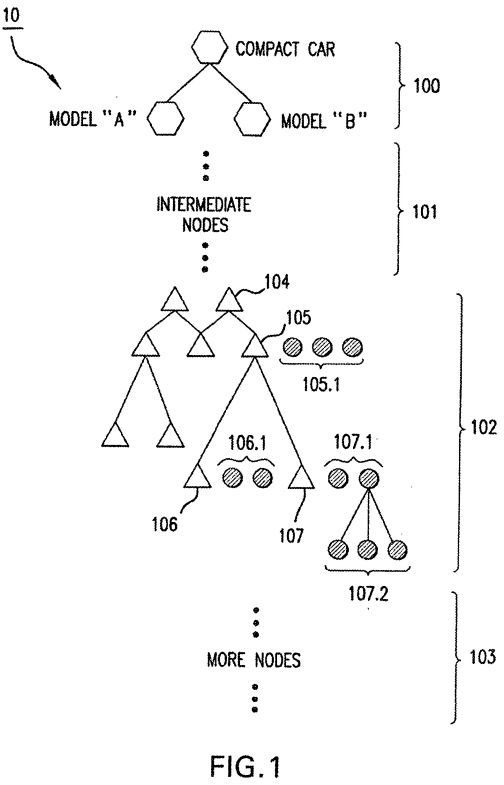
The invention

This European patent application addressed the problem of modelling a “family” of products. Instead of providing a separate model for each variation of a product, a single “product data-model” is provided that captures the whole family. This product data-model models a generic product by means of a number of “logical component-usage” nodes. Each “logical component-usage” node essentially represents a logical component function and is connected, by means of a number of “component-usage” nodes, to respective “components” providing such function. The “component-usage” nodes thus represent configuration options for the “logical component-usage” node. By applying certain “applicability attributes”, at each “logical component-usage” node a choice is made from the possible “component-usages” and their corresponding “components”.

Fig. 2 of EP 1 357 486

  • Claim 1 (main request)

Is it patentable?

First of all, the Board noted that, although the patent claim mentioned “designing” and “manufacturing” products, it did not actually include any steps in this regard:

Although claim 1 of the main request is directed to a “method of designing products using CAD and of manufacturing products using CAM”, it does not define any steps, let alone steps of designing products using CAD and of manufacturing products using CAM. Instead, claim 1 defines features of a “product data-model” without explaining its relation to a method of designing or manufacturing.

In this respect, the Board notes that the invention as disclosed in the application also rather appears to be concerned with the general use of a particular “product data-model” stored in the memory of a computer in unspecified activities related to CAD/CAM.

The actual subject-matter, namely the definition of an information model, was considered to be non-technical:

The features of claim 1 relating to the “product data-model” define an abstract information model. Indeed, these features are worded in abstract terms and make no reference to any concrete physical representation of the product data-model.

According to decision T 49/99 of 5 March 2002, reasons 7, information modelling is in principle a non-technical activity, and only a purposive use of information modelling in the context of a solution to a technical problem may contribute to the technical character of an invention. For the reasons given under point 2.32.3 , the Board considers that the claimed connection with CAD/CAM activities cannot qualify as such a purposive technical use. The product data-model does not enable, improve, or otherwise contribute to the solution of a concrete technical problem.

Therefore, the Board ultimately decided that the patent application does not provide any technical contribution that could be the basis for an inventive step.

More information

You can read the whole decision here: T 0042/09 (Logical hierarchical data model/BOEING) of 10.3.2014

Classifying and linking data records: non-technical

This is the second decision (read the first one here) cited by the EPO in the artificial intelligence-related section G-II, 3.3.1 of the revised Guidelines for Examination of the EPO, in force since November 2018. Here are the practical takeaways from the decision  T 1784/06 (Classification method/COMPTEL) of Technical Board of Appeal 3.5.01:

Key takeaways

The COMVIK approach also has to be applied when the subject-matter has to be assessed under Art. 56 EPC 1973.

Where an intrinsically non-technical solution sought to derive a technical character from the problem solved, the problem had to be technical.

The automatic classification of data records serves only the purpose of classifying the data records, without implying any technical use of the classification.

The invention

The invention relates to a method for classifying and selecting records, e.g. for selecting rating for telephone network or other telecommunications network event data.

Fig. 4 of EP 1 496 452

  • Claim 1 (main request)

Is it patentable?

The Board ruled that the features of claim 1 that refer to the algorithmic details would not contribute to the technical character. The main reason is, according to the Board, that the claim is not limited to any technical application. Moreover, the description would only refer to the purpose of billing, which is not considered technical:

3.1.4 The application may disclose a robust algorithm which is immune to variations in the number of classes to be recognized. This may be a valuable mathematical property of the algorithm and would imply technical benefits when used for a technical purpose. However, claim 1 is not limited to any technical application of its classification method. According to the description, the data records are classified for the non-technical purpose of billing.

3.1.5 As the algorithm of claim 1 does not contribute to the technical character of the classification method, it does not enter into the examination for inventive step.

To argue patentability, the appellant outlined that the requirement of a technical problem when applying the problem-and-solution approach cannot be deduced from the regulations under the EPC. Moreover, the appellant pointed to several decisions where it was ruled that a non technical problem may have a technical solution:

2.3 Regarding the Board’s insistence an a technical problem when applying the problem-and-solution approach, the appellant disputes that such a requirement can be deduced from the EPC or introduced from its Implementing Regulations. The appellant refers inter alia to decision T 473/08 (by a different Board of Appeal) to point out that “a non-technical problem can have a technical solution“. However, there is no divergence, the Board agrees to the statement that a non-technical problem can have a technical solution. On the other hand, where an intrinsically non-technical solution (mathematical algorithm) seeks to derive a technical character from the problem solved, the problem must be technical. This is the point an which the present case hinges.

How the EPO examines software patentsBy the way, if you are interested in a deeper look into how the European Patent Office examines software-related inventions, this 30-minute video gives a concise overview of the “two hurdle” approach with lots of examples.

Furthermore, the appellant questioned whether the COMVIK approach could be applied to applications which have to be assessed under Art. 56 EPC 1973. Moreover, the appellant held the opinion that the claimed subject-matter has to be assessed as a whole when it comes to assessing inventive step. However, the Board argued that even before the COMVIK approach was established, non-technical features were considered as irrelevant for the assessment of inventive step:

2.1 […] Already before the Comvik decision, technically non-functional modifications were considered as irrelevant to inventive step (see e.g. T 72/95 dated 18 March 1998, point 5.4).

2.2 According to the appellant, claimed subject-matter as a whole should be examined for the presence of an inventive step once the subject-matter as a whole has been found to meet the technology criterion of Article 52(1)(2)(3) EPC. The appellant argues that Article 56
EPC 1973 should be applied independently of Article 52(1)(2)(3) EPC because Article 52(2) EPC has to be applied independently of Article 56 EPC 1973 […].

The Board does not accept such formal reasoning and points out that it is normal and often necessary for legal provisions to be in an asymmetric relationship or hierarchical dependency. For example, the novelty of a claim has to be examined independently of inventive
step considerations, whereas a finding of inventiveness presupposes a novelty examination. […]

In view of the above, the Board dismissed the appeal.

More information

You can read the whole decision here: T 1784/06 (Classification method/COMPTEL) of September 21, 2012

Classification of text documents: non-technical

While this is not a brand new software-related decision, it appears to be highly relevant because it is one out of two decisions cited in the artificial intelligence-related section G-II, 3.3.1 of the revised Guidelines for Examination of the EPO, which are in force since November 2018. In this decision, the European Patent Office refused to grant a software patent for a classifying text documents based on their content. Here are the practical takeaways from the decision T 1358/09 (Classification/BDGB ENTERPRISE SOFTWARE) of Technical Board of Appeal 3.5.06:

Key takeaways

Whether two text documents in respect of their textual content belong to the same “class” of documents is not a technical issue.

A comparison with what a human being would do is not a suitable basis for distinguishing between technical and non-technical steps.

The mere fact that an algorithm leads to reproducible results does not imply that it makes a technical contribution.

The invention

The European patent application relates to a highly efficient and flexible method and an apparatus for building a classification scheme which can be used to classify text documents in an efficient and flexible manner.  This is done by first building a “classification model” and then classifying documents using this classification model.

Fig. 2 of WO 00/67150

  • Claim 1

Is it patentable?

According to the Board, determining whether two text documents belong to the same class does not provide a technical contribution:

5.2 A mathematical algorithm contributes to the technical character of a computer-implemented method only in so far as it serves a technical purpose (see decision T 1784/06 of 21 September 2012, reasons 3.1.1). In the present case, the algorithm serves the general purpose of classifying text documents.

Classification of text documents is certainly useful, as it may help to locate text documents with a relevant cognitive content, but in the Board’s view it does not qualify as a technical purpose. Whether two text documents in respect of their textual content belong to the same “class” of documents is not a technical issue. […]

To convince the Board of the patentability of the claimed subject-matter, the appellant argued that a human being would manually read through the document and assign a particular class to it on the basis of his understanding of the document. In contrast, the claimed automatic classification method involved precise computation steps which no human being would ever perform when classifying documents.

However, the Board takes the position that a comparison with what a human being would do is not a suitable basis for distinguishing between technical and non-technical steps:

5.4 The Board agrees that a human being would not apply the claimed classification method to perform the task of classifying text documents. The Board further accepts that the proposed computerised method may be faster than classification methods known from the prior art. However, the determination of the claim features which contribute to the technical character of the invention is made, at least in principle, without reference to the prior art (cf. T 154/04, OJ EPO 2008, 46, reasons 5, under (E) and (F)). It follows that a comparison with what a human being would do or with what is known from the prior art is not a suitable basis for distinguishing between technical and non-technical steps (see also decision T 1954/08 of 6 March 2013, reasons 6.2).

By the way, if you are interested in a deeper look into how the European Patent Office examines software-related inventions, this article provides some more details thereon.

The appellant further argued that the claimed method provided more reliable and objective results than manual classification which was not contested by the Board. However, the Board stated that the mere fact that an algorithm leads to reproducible results does not imply that it makes a technical contribution:

5.6  The Board does not contest that the claimed classification method may provide reliable and  objective results, but this is an inherent property of deterministic algorithms. The mere fact that an algorithm leads to reproducible results does not imply that it makes a technical contribution.

As a result, the Board ruled that a the claimed mathematical algorithm does not contribute to the technial character of the claimed method. The only implementation features specified in the claim are references to the method being “computerized” and the text documents being “digitally represented in a computer”. The skilled person, when given the task of implementing the algorithm, would certainly have chosen to represent text documents “digitally in a computer”. The Board further considers that the skilled person, using only his common general knowledge, would have had
no difficulty in implementing on a computer the various steps of claim 1 and thus rejected the present application due to lack of inventive step.

More information

You can read the whole decision here: T 1358/09 (Classification/BDGB ENTERPRISE SOFTWARE) of November 21, 2014

EUROPEAN SOFTWARE PATENTS February 2019 updates

February 2019 marks the proud start of EUROPEAN SOFTWARE PATENTS with the first batch of decisions:

Two somewhat older decisions relate to the very fundamentals of the EPO’s software patent examination standard: According to the “any hardware approach”, the patent eligibility hurdle only requires one single technical feature (e.g. a computer). The challenging test for most European software patents is inventive step, where only those features which contribute to the solution of a technical problem are taken into account (the so-called “Comvik approach”).

(more…)

Method for calendar-based profile switching: non-technical

The European Patent Office refused to grant a European software patent for calendar-based profile switching on small computer devices. Here are the practical takeaways from the decision  T 1989/12 (Calendar-based profile switching / MICROSOFT) of Technical Board of Appeal 3.5.01:

Key takeaways

Non-technical features cannot contribute to inventive step. Therefore, they may legitimately appear in the formulation of the problem to be solved without constituting hindsight.

Hence, formulating the technical problem to be solved may comprise elements of the solution as long as they lack technical character.

The invention

The application relates to small, portable computing devices, and particularly to computing devices that provide user notifications relating to particular events. According to an embodiment, the invention provides control of user notifications for different environments through the use of customized notification profiles. Each profile has information related to each type of notification event (such as a meeting reminder, a button press among others) and a corresponding notification type (such as an audible chime, a visual display, among others) for each notification event. Thus, each profile may be configured to provide different types of notifications for a plurality of different types of notification-type events.

Fig. 1 of EP 1 217 532

  • Claim 1 (auxiliary request)

Is it patentable?

The application describes that, in the prior art, the user could control the notifications by putting the phone on silent mode. However, the silent mode is inflexible in that it applies to all types of notifications and events. Thus, if the user is expecting an important telephone call during a meeting, it is not possible to receive a sound notification for that important call when the phone is on silent.

According to the assessment of the examining division, to which the Board agrees, the claimed subject-matter differs from the prior art in several features:

3.1 The examining division assessed inventive step starting from D3 and the Board agrees that this is a reasonable starting point. D3 discloses a mobile phone having a plurality of notification profiles (for example “General”, “Silent”, and “Meeting” – see pages 53 and 54, as well as the table on page 142). The user can select a profile from the settings menu (pages 146 and 147).

3.2 It is common ground that the method of claim 1 of the auxiliary request differs from D3 by the automated profile switching:
“if the user has selected an automated profile switching, the method further comprises:
upon occurrence of a calendar-related event, determining whether a notification mode has been set for the calendar-related event;
if no notification mode has been set, remaining in the current notification mode;
if a notification mode has been set, automatically applying the selected notification mode;
upon ending of the calendar-related event, automatically switching back to the current notification mode”.

The examining division formulated the problem to be solved as “how to couple the notification modes with the calendar”. Since this involves elements of the solution, namely the recognition that the notification mode should be coupled with calendar functionality, this can only be allowable if the concept is not technical.

3.4 The next step in the assessment of inventive step is to formulate the objective technical problem solved by the invention. This is often a crucial issue, because the problem defines what is given to the skilled person. A broadly formulated problem leaves a lot for the skilled person to solve. A narrowly formulated problem, on the other hand, puts the skilled person closer to the invention. The limit is the point just before elements of the solution enter into the problem (impermissible hindsight).

In all cases, non-technical features cannot contribute to inventive step. Therefore, they may legitimately appear in the formulation of the problem to be solved without constituting such hindsight (T 641/00 – Two identities/COMVIK). Applicant argued that the computer-implemented method as claimed provides an efficient and flexible way for allocating resources. Moreover the claimed method allegedly minimizes data transfer via the use of a remote reference.

The Board agrees in that it the claimed concept is not technical. Hence, most of the features present in claim 1 must not be taken into account for assessing inventive step:

3.6 The Board agrees that it is not. Moreover, the Board goes further than the examining division and considers also the settings themselves to be non-technical. Those settings do nothing more than provide the user with options. The global setting allows the user to switch the automatic profile switching on or off. The local setting allows the user to specify a notification profile for each event. The Board sees none of this as technical. Therefore, all of it is part of the problem to be solved in the form of a requirement specification given to the skilled person. This is a narrow problem. The only thing that is left for the skilled person to do is to implement the requirements on the mobile device. In the Board’s view, this would have been obvious.

In conclusion, the Board ruled that the subject-matter of claim 1 does not involve an inventive step (Article 56 EPC).

More information

You can read the whole decision here: T 1989/12 (Calendar-based profile switching / MICROSOFT) of April 26, 2018