Author Archive

Automated script grading: non-technical

The invention relates to automated assessment of scripts written in examination. The Examining Division refused the application, as the features were primarily mathematical or linguistic operations, and no clear technical purpose was inherent as it related to grading written scripts. The Appellant argued that the invention provided technical contribution in “educational technology” and automatically graded text scripts so that the grades closely match those given by humans.

The Board disagreed with the applicant and considered that the human grading process was a cognitive task and could not be properly defined to assess if a problem was solved. Furthermore, while the training model may have a technical contribution, it was in the field of mathematics and also not considered. The Board noted that at least an indirect link to physical reality was required, and since automated script grading for evaluating linguistic competencies did not have an implied technical use or purpose, it was not considered for assessing inventive step. 

Here are the practical takeaways from the decision T 0761/20 (Automated script grading/UNIVERSITY OF CAMBRIDGE) of May 22, 2023, of the Technical Board of Appeal 3.5.06.

Key takeaways

Human grading process is a cognitive task in which the marker evaluates the content of the script (e.g. language richness and grammatical correctness) to assign a grade. Thus the problem of automating script grading is not defined well enough that one can pro­perly assess whether it has been solved.

A claimed training procedure might constitute a technical contribution to the state of the art. Taken alone, however, this is a mathematical method, so this contribution is in the – excluded – field of mathematical methods and is therefore not a patentable contribution.

According to G 1/19, a direct link with physical reality is not required for a technical effect to exist. However an at least indirect link to physical reality, internal or external to the computer, is required. The link can be mediated by the intended use or purpose of the invention (“when executed” or when put to its “implied technical use”).

Automated script grading, by itself or via its intended use for evaluating linguistic competences, does not have an implied use or purpose which would be technical via any direct or indirect link with physical reality.

The invention

The invention was defined by the Board as follows:

1. The application relates to automated assessment of scripts written in examination, in particular English for Speakers of Other Languages (ESOL) examinations (paragraphs 1 to 3).

1.1 The system comprises a feature analysis module, denoted as RASP (robust accurate statistical parsing) which extracts and numerically quantifies linguistic features of text (paragraphs 52 to 56) to form a feature vector.

1.2 This feature vector is used to grade scripts on the basis of discriminative models, such as SVM or large margin perceptrons, including a variant, said to be new, called the Timed Aggregate Perceptron (TAP, see paragraph 28). In the TAP training procedure, unlike in standard perceptron training, a timing parameter redu­ces the update rate as a function of how far the pro­cess has progressed, of the magnitude of the increase in empirical loss, and of the balance of the training distributions (paragraph 36). This has the role of providing an approximate solution that prevents overfitting (by early stopping).

1.3 The application describes embodiments with binary outputs based on SVM or TAP, useful for pass/fail gra­ding systems (paragraphs 24 to 39), and an embodiment denoted as a modification of the TAP using preference ranking (paragraphs 41 to 49).

1.4 In the latter embodiment, the perceptron’s success is measured by its ability to correctly rank pairs of training samples on the basis of its scalar output; this scheme is conceptually aimed at reducing errors in relative grading (i.e. the decision which test to assign a higher score) as opposed to errors in absolute grading. The output of a perceptron is in essence the result of a dot product between the learned weight vector and the incoming sample. In the standard perceptron, to reduce the ranking errors, the weight vector is updated in the direction of the misclassified samples; in the proposed variant, the update direction is provided by the sum of the difference vectors between the samples of the misclassified pairs. This variant can be used both for binary fail/pass grading and for non-binary grading.

1.5 The application discloses performance assessments of the described methods (paragraphs 62 to 73) based on how well its results correlate with those of prior art systems and of human markers (or examiners/raters) (see Tables 4 and 5, paragraphs 63 and 71). According to those results, the preference ranking TAP model outputs grades that correlate with those provided by human markers almost as well as the human markers’ grades correlate with one other. Also, the preference ranking TAP outperforms TAP on a binary task, while binary TAP and SVM outperform prior art systems.

1.6 The requests on file are all based on the TAP preference ranking model.
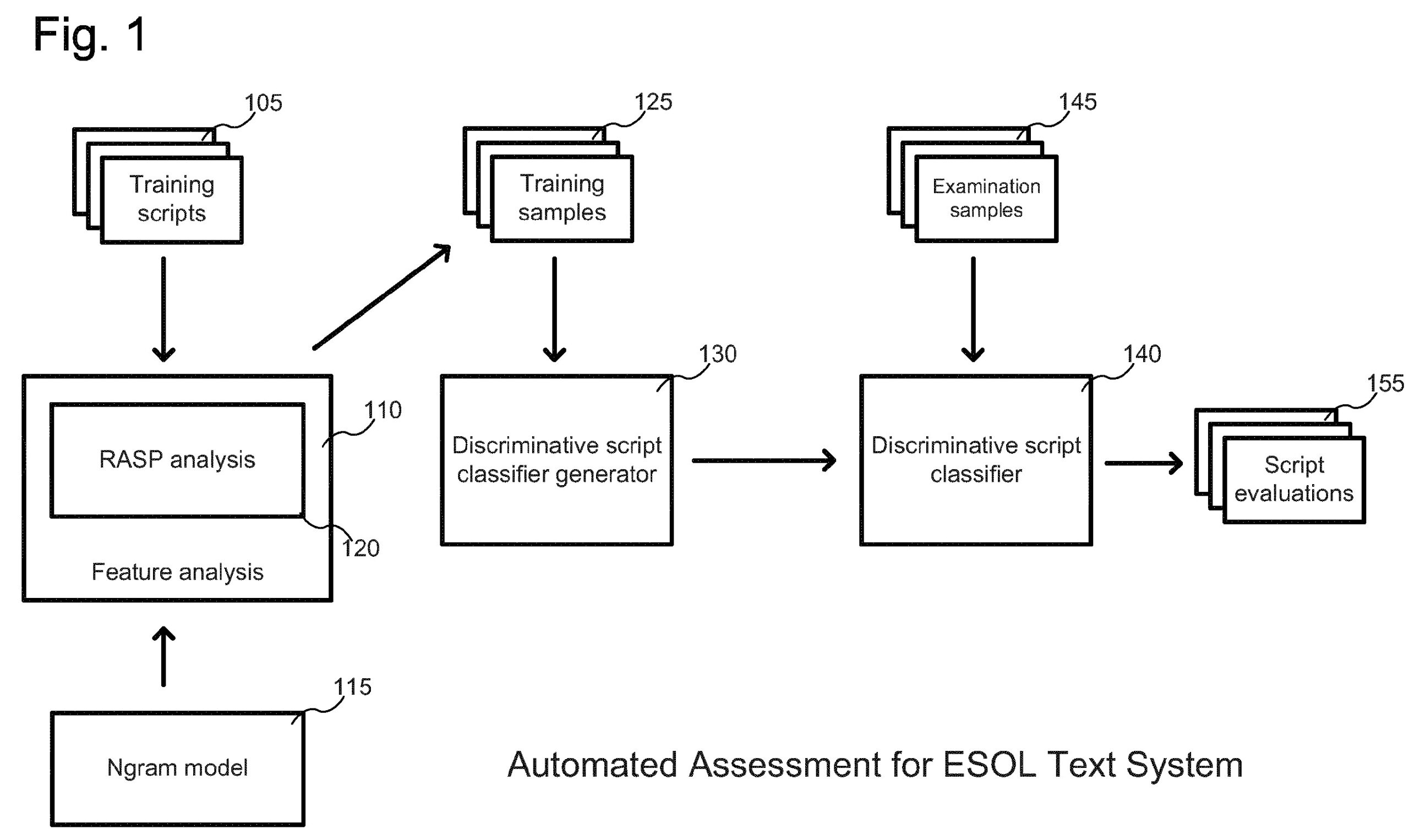
Fig.1 of EP 2 439 684 A2
  • Method Claim 1

Is it patentable?

In the decision under appeal, the Examining Division considered that the features are primarily mathematical or linguistic operations performed on a regular computer. There was no clear technical purpose, especially because grading text scripts is not inherently a technical task.

The Appellant argued that, even though grading scripts by a human marker might not be a technical task in itself, their invention does provide a technical contribution in the field of “educational technology,” which combines computer hardware, software, and educational theory to enhance learning, by providing automatically graded text scripts so that the grades closely match those given by humans. The system, can handle more complex responses and it uses novel AI techniques to provide more accurate grading, and can provide students immediate feedback, which improves their learning experience.

The Board assessed if the claim, as a whole, was linked to a technical effect:

6. As the Board understands the argument of the Examining Division, it does not depend on whether the differences to D2 also comprise the ones advanced by the Appellant, as the claim as a whole can be said to only define “mathematical or linguistic steps” used for “grading text scripts”. This means that, if the argument of the Examining Division is correct, the claim as a whole is not “causally linked to a technical effect”.

7. Also the Appellant, challenging the finding of the Exa­mining Division, refers to the claim as a whole when it states an alleged contribution to the art and the corres­ponding technical problem solved. This is appro­priate, as the specific effects of any distinguishing features over D2 are only relevant for inventive step if it can be acknowledged at all that a technical prob­lem is solved. If that is the case, the differences themselves might give rise, for instance, to an ar­gu­ment that the results according to the invention corre­late better with those of human markers than the prior art methods (instead of merely “well”).

8. The Board shares this view and will therefore also address the claim in its entirety to assess whether a combination of features solving a technical problem can be identified.

9. The claim defines a method of automated script grading using machine learning, which is effectively a computer implemented process. Such processes may have technical effects – and thus be deemed to solve a technical problem – at their input or output, but also by way of their execution (see G 1/19, reasons 85). A technical effect may also be acknowledged in view of their pur­pose, i.e. an (implied) technical use of their output (see G 1/19, reasons 137).

The Board then assessd if the technical effects was “within the computer”:

10. The claimed method contains steps for extracting nume­rical “linguistic” vectors from scripts (for all con­sidered samples, training scripts and scripts to be graded), a step of training a perceptron, and a step of using the perceptron to grade the scripts.

10.1 The extraction of linguistic vectors, which is the step providing the input to the grading perceptron, is not detailed in the claim. According to the description (see paragraph 52), they are defined and selected to capture sufficient information for evaluating the de­gree of linguistic competence; they can be said to pro­vide a “mathematical” summary of a script. Since the claim provides no detail as to the contents of the vector, this step cannot be considered to provide any contribution on its own, be it related to the script acquisition (e.g. scanning or OCR) or modelling, or to any optimization within the computer.

10.2 The claimed perceptron model is a linear mathematical function mapping the input numerical vectors to output grades. Specific details are only claimed with regard to its training procedure, which is optimized to pre­serve the ranking of grades, as opposed to minimizing the absolute error in output grades (see point 1.4 above). The model is not based on technical conside­ra­tions relating to the internal functioning of a compu­ter (e.g. targeting specific hardware or satisfying certain computational requirements), and the preference ranking is chosen merely according to its educational purpose, which does not relate to any effects within the computer either.

10.3 Also the final step of using the perceptron to grade the scripts provides no effects within the computer.

11. In principle, the claimed training procedure might constitute a technical contribution to the state of the art (see e.g. G1/19, reasons 33). Taken alone, however, this is a mathematical method, so this contribution is in the – excluded – field of mathematical methods (see T 0702/20 and T 0755/18, catchwords) and is therefore not a patentable contribution.

12. Thus the Board cannot identify any technical problem solved be it at the input, or in generating the output grade output, or by execution of the claimed process.

The Board then assessd if the technical effect via an “implied technical use” is provided:

13. What remains as a potentially patentable contribution is the purpose of the claimed system to provide an automated tool for script grading. This corresponds to the problem formulated by the Appellant, namely “provi­ding a computer system that can automatically grade text scripts [and provide grades] that correlate well with the grades provided by human markers”. The ques­tions to be answered are (i) whether this problem is, or implies, a technical one, and (ii) whether it is actually solved (T 641/00, reasons 5 and 6).

14. Turning first to question (ii), the Board remarks that the human grading process is a cognitive task in which the marker evaluates the content of the script (e.g. language richness and grammatical correctness) to assign a grade.

14.1 The assigned grade depends on the content of the script itself, but is also at least partly subjective: the marker will have preferences as to style and language, and will be influenced by experience and grades assigned to scripts in the past.

14.2 The Board thus doubts that the problem of automating script grading is defined well enough that one can pro­perly assess whether it has been solved, i.e. in the sense that it provides a system that can actually re­place different human markers and provide “correct” grades.

14.3 The Appellant has captured this in the problem formu­la­tion by the qualifier “correlate well”. Given the re­sults in the application, showing that the claimed sys­tem provides results that agree with the ground truth on the same level as the markers agree with each other, the Board is satisfied that the system can produce out­puts that “correlate well” with the training data from human markers. The Board has no occasion to challenge that the invention may for instance be useful, as the Appellant submitted, for the (self-)evaluation of linguistic competences by students.

15. In its communication, the Board questioned under Article 84 EPC whether the claims of the main request comprised all the features necessary to produce this result. However, given that the Appellant was willing to amend the claims to overcome this objection, the Board leaves this question open and proceeds on the assumption that the problem, as qualified by the Appellant, is solved.

16. Under this assumption, there is a first argument that any automation of human tasks, irrespective of the task, is sufficient to conclude that a technical problem is solved, as it reduces human labor.

16.1 This argument, however, contradicts the requirement of G 1/19 that there must be a technical purpose. Though G 1/19 was related to computer-implemented simulations, its reasons apply to computer-implemented methods other than simulations as well.

16.2 The Enlarged Board stated that “information which may reflect properties possibly occurring in the real world […] may be used in many different ways”, that “a claim concerning the calculation of technical information with no limitation to specific technical uses would therefore routinely raise concerns with respect to the principle that the claimed subject-matter has to be a technical invention” (reasons 98), and that “[i]f the claimed process results in a set of numerical values, it depends on the further use of such data (which use can happen as a result of human inter­ven­tion or automatically within a wider technical pro­cess) whether a resulting technical effect can be con­sidered in that assessment” (reasons 124), and conclu­ded that “such further [technical] use has to be at least implicitly specified in the claim” (reasons 137).

16.3 Therefore, the argument that a technical problem is already solved by the mere provision of any automated tool cannot succeed.

17. As stated above, the Board assumes that the claimed invention serves the purpose of supporting its users in evaluating linguistic competences, as the Appellant argued. The Board also cannot see any other implied purposes. The question remains whether the assessment of linguistic competences, or maybe merely providing a grade, is a technical purpose.

The appeallant then argued that education technolgy was a technical field and raised the question of what is a technical field, or field of technology?

18. The Appellant considers that automated grading makes a technical contribution in the field of “educational technology” and, if the Board disagrees, asks the question “what is a technical field?” or “a field of technology?”.

19. The Board understands these two questions to be equiva­lent. The express reference to “fields of techno­logy” in Article 52(1) EPC, introduced with the EPC 2000 in order to bring Article 52 EPC in line with Article 27(1) TRIPS, was not intended to change the established understanding that patent protection is “reserved for creations in a technical field”, i.e. involving a “tech­nical teaching […] as to how to solve a parti­cu­lar technical problem” (see OJ EPO Special edition 4/2007, 48, but also G 1/19, reasons 24, and T 1784/06, reasons 2.4).

19.1 The Board further notes that the field of “educational technology” as defined by the Appellant (see point 5 above) is a rather inhomogeneous one, covering insights from – and presumably contributions to – a wide range of “fields”, technical ones and non-technical ones. It appears questionable, therefore, that this field can be considered a technical one as a whole. However, this question is not decisive.

19.2 What is decisive, according to established case law of the Boards of appeal, is whether the invention makes a contribution which may be qualified as technical in that it provides a solution to a technical problem. If this is the case, a contribution to a field of techno­lo­gy may be said to also be present. It is noted that the “field” of this contribution may be different from the one to which the patent more generally re­lates: for instance, inventions within the broad field of “educational technology” may make contributions in the field of computer science.

20. In G 1/19, the Enlarged Board followed its earlier case law and “refrain[ed] from putting forward a definition for ‘technical'”, because this term must remain open (section E.I.a, especially reasons 75 and 76; see also OJ EPO Special Edition 4/2007, 48). Nonetheless, the Enlarged Board provided considerations as to what may be considered technical.

20.1 The referring Board had suggested that a technical effect might require a “direct link with physical reality, such as a change in or a measurement of a physical entity” (see T 489/14, reasons 11).

20.2 The Enlarged Board accepted that such a “direct link with physical reality […] is in most cases sufficient to establish technicality” (reasons 88) and, in this context, that “[i]t is generally acknowledged that measurements have technical character since they are based on an interaction with physical reality at the outset of the measurement method” (reasons 99). It also stressed that an effect could also be “within the computer system or network” (i.e. internal rather than “(external) physical reality”, see G 1/19, reasons 51 and 88).

20.3 It recalled that potential technical effects might also be sufficient (see also reasons E.I.e), i.e. “effects which, for example when a computer program […] is put to its intended use, necessarily become real technical effects” (reasons 97).

20.4 And it also considered that calculated data, while “rou­tinely raising concerns with respect to the prin­ciple that the claimed subject-matter has to be a tech­nical invention over substantially the whole scope of the claims” might contribute to a technical effect by way of an implied technical use (reasons 98 and 137), “e.g. a use having an impact on physical reali­ty” (rea­sons 137).

20.5 While the Enlarged Board of Appeal has thus found that a direct link with physical reality may not be required for a technical effect to exist, it has, in this Board’s view, confirmed that an at least indirect link to physical reality, internal or external to the computer, is indeed required. The link can be mediated by the intended use or purpose of the invention (“when executed” or when put to its “implied technical use”).

21. Returning to the case at hand, the Board finds that automated script grading, by itself or via its intended use for evaluating linguistic competences, does not have an implied use or purpose which would be technical via any direct or indirect link with physical reality.

The Board found method of automated script grading does not provide a contribution to any technical and non-excluded field, be it by way of how the automation is carried out, or by way of its use. Therefore, it could not be considered for assessment of inventive step.

More information

You can read the full decision here: T 0761/20 (Automated script grading/UNIVERSITY OF CAMBRIDGE) of May 22, 2023, of the Technical Board of Appeal 3.5.06.

Stay in the loop

Never miss a beat by subscribing to the email newsletter. Please see our Privacy Policy.

Privacy policy
* = Required field

Handling data requests on database using improved update indicator: technical

The invention relates to handling data requests on a database by using an improved update indicator. The Examining Division refused the application, alleging that although caching was a technical principle, the content of the cache (prepared cache) was not technical. The Board noted that technical use of the returned results was not claimed. In any event, improving the functioning of a computer system in terms of speed and resource usage can have a technical effect, particularly if the improvement is based on technical considerations. 

Based on the simulation data provided by the application, the Board agreed with the applicant that the claimed update indicator was not merely a trade-off between resource usage and the validity of returned search results but implements a specific strategy that credibly achieves a better trade-off curve (overall validity as a function of resource usage) than other update indicators. Therefore, the subject-matter was inventive.

Here are the practical takeaways from the decision T 0729/21 (Handling data requests/AMADEUS) dated May 02, 2023, of the Technical Board of Appeal 3.5.07.

Key takeaways

Improving the functioning of a computer system in terms of speed and resource usage can itself be a technical effect, in particular if the improvement is based on technical considerations

Update indicator which does not merely represent a trade-off between resource usage and the validity of returned search results, but implements a specific strategy which credibly achieves a better trade-off curve (overall validity as a function of resource usage) than other update indicators, is technical

The invention

This invention is about handling data requests for a database. The database has two parts: one with “original results” retrieved in real-time from the database, and another with “prepared results”, prepared in advance.  To speed up request handling, the previous original results were saved as prepared results. These prepared results were given back when data was requested.

To ensure freshness, each prepared result has an “update indicator” showing if it needs updating. So, when a data request comes in, the control unit checks the prepared result’s update indicator against a limit, and if it needs to update the original results, gets an updated version from the original results. If no update is needed, the control unit gives the original (not-updated) result.

Importantly, the invention relates to how the update indicator was calculated “(1 – acc) · t”, where “acc” is the probability that the prepared result is valid, “t” is its age. The probability “acc” is “e^(-λt)”, where “λ” shows how often the prepared result changes. This follows a Poisson process with a rate “λ” linked to the prepared result.

Fig. 1 of EP 3 392 788 A1
  • Method Claim

Is it patentable?

In the decision under appeal, the examining division held that the subject-matter of claim 1 lacked an inventive step. In particular, although caching was a technical principle, the content of the cache (prepared cache) was not technical.

In the inventive step assessment, the Board considered two cited documents. One (document D5) related to a system for determining airline seat availability information, where the process includes an update indicator for comparing the prepared result with the time that has passed since the result was stored. While the other (document D2) was concerned with the problem of keeping a database of cached/prepared results fresh, which includes updating the results in different order or uniformly. The assessment of the Board was as follows:

9.1 The board considers document D5 to be a suitable starting point for assessing inventive step.

In view of the analysis presented in point 7. above, the subject-matter of claim 1 differs from the disclosure of document D5 in that the update indicator is defined as “(1 – acc) · t”, i.e. the prepared result is updated if “(1 – acc) · t” exceeds a threshold value, where acc = e^(-λt), t is the age of the prepared result, and the validity rate lambda is an indicator of how frequently the prepared result changes.

In document D5, the update indicator is “t”, i.e. the prepared result is updated if its age “t” exceeds a threshold value.

9.2 The appellant submitted that the claimed update indicator “(1 – acc) · t” improved the validity (or “freshness” in the terminology of document D2) of the data kept in the cache.

9.3 In its decision, the examining division argued that, although caching, i.e. serving locally stored results instead of fetching remote results, was a technical principle, in the present case the content of the cache, i.e. of the prepared results, was not technical. The update indicator implemented a trade-off between always updating requested results and always returning the prepared results without regard to their validity. Since no technical considerations were apparent in the choice of the update indicator, this trade-off reflected a non-technical user requirement.

9.4 The board agrees that claim 1 does not express any technical use of the returned results. However, improving the functioning of a computer system in terms of speed and resource usage can itself be a technical effect, in particular if the improvement is based on technical considerations. As the examining division acknowledged, caching mechanisms are normally based on such technical considerations.

Moreover, in the present case the claimed update indicator does not merely represent a trade-off between resource usage and the validity of returned search results; rather, it implements a specific strategy which – at least according to the application – achieves a better trade-off curve (overall validity as a function of resource usage) than other update indicators.

However, according to the EPO jurisprudence, a technical problem may be regarded as being solved only if it is credible that substantially all claimed embodiments exhibit the technical effects upon which the invention is based:

9.5 The board therefore accepts that the distinguishing feature may in principle achieve a technical effect over the prior art. However, it still has to be assessed whether such a technical effect is credibly achieved over the whole claimed scope.

9.7 The description of the present application, on page 14, line 26, to page 16, line 18, gives reasons why the claimed update indicator “(1 – acc) · t” is an improvement over the update indicator “(1 – acc)”, previously known from document D3. The board considers this improvement to be credible in view of the fact that an update strategy based on the update indicator “(1 – acc)” is likely to spend (too) many resources on updating prepared results with a high rate of change, which then quickly become inaccurate again and require a new update.

However, prior-art document D5 does not use “(1 – acc)” but the age “t” of a prepared result as the update indicator.

The Board noted that document D2 suggests using the update indicator “t” to improve the freshness. Therefore, in the communication prior to Oral Proceedings, the Board raised doubts if the update indicator “(1 – acc) · t” performed better than the update indicator “t”. The applicant alleviated these concerns by providing simulation data using graphs:

9.10 During the oral proceedings before the board, the appellant gave the board more insight into its pre-filing documentation, which convinced the board that the three simulated strategies indeed correspond to the update indicators “t”, “(1 – acc)” and “(1 – acc) · t”.

The graphs confirm that the update indicators “t” and “(1 – acc) · t” both outperform the update indicator “(1 – acc)” by a significant margin. Moreover, the simulation results for the claimed update indicator “(1 – acc) · t” are slightly better than those for the update indicator “t” of document D5.

9.11 The board is aware that the simulation results presented by the appellant correspond to only a single data point and do not amount to conclusive evidence that the distinguishing feature achieves an improvement over the whole scope of claim 1.

However, this single data point is sufficient to refute the board’s doubts about the credibility of the alleged technical effect, which were based solely on the teaching in document D2 that the “uniform allocation policy”, corresponding to the update indicator “t” of document D5, while not optimal, is significantly better than the “proportional allocation policy”, corresponding to the update indicator “(1 – acc)”. In the absence of any further substantiated doubts, the board considers that it has to accept that the improvement on which the appellant relies indeed exists (see decision T 578/06, Reasons 21).

The Board then granted the patent based on the request.

More information

You can read the full decision here: T 0729/21 (Handling data requests/AMADEUS) dated May 02, 2023 of the Technical Board of Appeal 3.5.07.

Stay in the loop

Never miss a beat by subscribing to the email newsletter. Please see our Privacy Policy.

Privacy policy
* = Required field

Automatic update and execution of a flight plan based on a detected runway configuration: technical

The invention relates to an automatic update and execution of a flight plan based on a detected runway configuration. The Examining Division refused the application alleging the determination of the runway configuration was not technical and it was purely algorithmic techniques determining the direction in which to land or start and calculating the shortest way to get there merely reflected a “resource scheduling and traveling salesman approach”.

The Board agreed with the applicant that although operational research algorithms may well be involved in the recalculation of the flight plan, it is not a  computer-based implementation of a resource scheduling or traveling salesman algorithm. While the assignment and update of runway configurations may be considered administrative measures, determining an airport’s current runway configuration using computer means and based on surveillance data has a technical character and allows automatically adapting the aircraft’s route to the current runway configuration.

Here are the practical takeaways from the decision T 0270/20 (Runway configuration/BOEING) of the Technical Board of Appeal 3.5.01.

Key takeaways

While the assignment and update of runway configurations may be considered administrative measures,  determining an airport’s current runway configuration using computer means and based on surveillance data has a technical character.

Automatically adapting the aircraft’s route to the current runway configuration is technical.

The invention

The invention was summarised by the Board as follows:

The invention concerns the automatic update and execution of an airplane flight plan on the basis of the configuration of runways at a departure or destination airport (page 6, lines 5 to 12). While an early determination of the runway configuration can improve the efficiency of a flight plan, not all airports publish and regularly update this information. Known methods for estimating the runway configuration are computationally expensive, as they require the tracking and geometric modeling of the arriving and departing flights (description, page 1, lines 11 to 24).

To overcome these problems, a computer determines the current runway configuration using the airport’s surveillance data (for example, data provided by the automatic dependent surveillance-broadcast system or secondary radars), by defining a three-dimensional mesh centered on the airport and counting the number of airplanes in each cell of the mesh for a given time period (page 2, lines 5 to 20). A system installed on the aircraft then calculates and autonomously executes a new flight plan on the basis of the determined runway configuration (page 13, line 28 to page 14, line 11).

  • Claim 1 of the Main Request

Is it patentable?

In the decision under appeal, the examining division held that the subject-matter of claim 1 lacked inventive step as it was a straightforward implementation of non-technical features on a general-purpose computer. This was the finding of the Examining Division as summarised by the Board:

2. The examining division took the view that claim 1 of the sole request was a straightforward implementation of non-technical features on a general purpose computer.

In particular, the determination of the runway configuration was not considered technical, as it consisted of purely algorithmic techniques applied to data retrieved from well-known sources (e.g. radars). Determining the direction in which to land or start and calculating the shortest way to get there merely reflected a “resource scheduling and traveling salesman approach”.

Furthermore, the examining division interpreted the expression “autonomously executing, by a system installed on-board the aircraft, the updated flight plan” as merely indicating the display of the updated flight plan to the pilot, and therefore a presentation of information with no technical effect. It appears that this interpretation was based on the consideration that, in normal operation of the flight management system (FMS), “the execution of the flight plan means to display the flight plan to the pilot” (see decision, point 1.1.1). Since the actual route followed by the aircraft depended on the pilot’s intervention or reaction to the updated plan, the division argued the presence of a “broken technical chain” (in the sense of decision T 1741/08 – “GUI layout/SAP”), and thus the lack of a direct technical effect on the airplane.

However, the Board disagreed with the interpretation of the Examining Division as follows:

3. In the Board’s view, the examining division’s interpretation of the execution of the updated plan as a mere display of information is not warranted by the wording of the claim, not even when read in the light of the application as a whole. In particular, no part of the application suggests that the “execution” of the flight plan should be narrowly interpreted as “display”.

Moreover, according to the description, the updated flight plan can be transmitted to the Flight Management Unit (FMU) “for execution (e.g. to carry out an updated flight path or an updated taxiing plan)” (see page 14, lines 6 to 8). The Board notes that the function of a FMS in modern airplanes is not limited to presenting flight plans to the pilot. It executes a number of functions which include flight planning, navigation, lateral and vertical guidance, and can be operatively connected to the autopilot, to which the calculated steering and thrust commands can be transmitted for execution.

4. In view of the above, the Board is of the opinion that the skilled person would interpret the feature “autonomously executing, by a system installed onboard the aircraft, the updated flight plan (1330)” as implying a continuous and autonomous guidance of the aircraft according to the updated plan. Therefore, the examining division’s arguments regarding a possible “broken technical chain” must fail.

The Board is further of the opinion that the skilled person would be able, without undue burden, to program commonly known on-board flight control systems to autonomously execute the updated flight plan. The requirements of Article 83 EPC are therefore respected.

Based on this assessment, the Board agreed with the applicant that the features of the claim were technical:

5. The Board agrees with the appellant that the invention does not consist in the computer-based implementation of a resource scheduling or traveling salesman algorithm. Although operational research algorithms may well be involved in the recalculation of the flight plan, they are not even part of the claimed subject matter.

6. While the assignment and update of runway configurations may be considered administrative measures, in the Board’s view determining an airport’s current runway configuration using computer means and based on surveillance data in the manner described in claim 1 has a technical character.

7. Accordingly, the Board concludes that the examining division erred in considering the subject matter of claim 1 an obvious implementation of non-technical requirements on a general purpose computer.

All the features of claim 1 have a technical character and synergistically interact to automatically adapt the aircraft’s route to the current runway configuration. Hence, they should have all been taken into account for the assessment of inventive step.

The Board then granted the patent based on the request.

More information

You can read the full decision here: T 0270/20 (Runway configuration/BOEING) of the Technical Board of Appeal 3.5.01.

Stay in the loop

Never miss a beat by subscribing to the email newsletter. Please see our Privacy Policy.

Privacy policy
* = Required field

Securely Rendering Online Ads in a webpage: technical

The invention relates to rendering online ads on a webpage. The Examining Division refused the application alleging it related to purely business-orientated data transfer and generic presentation of business information. The Board disagreed. While advertisements as such are considered non-technical, the invention relates to an advertisement on a webpage realized as webpage programming code, digital pictures, film clips, or computer animation. These technical implementations of ads are considered technical, even if the purpose (advertisement) is non-technical.

The Board decided that since the features provided an animated, secured, and interactive cross-domain data exchange between two cross-domain frames in order to improve flexibility and security of communication of embedded content in websites, it was technical and considered inventive over the prior art.

Here are the practical takeaways from the decision  T 2177/19 of June 1, 2023, of the Technical Board of Appeal 3.4.03.

Key takeaways

Advertisements as such are considered non-technical. However, ad on a webpage in the form of digital web content is realised by programming code, digital pictures, film clips, or computer animation. These technical implementations of ads are considered technical.

Communicating requests and creating an interactive ad in the form of computer animation is technical and thus these features also have to be considered entirely technical even if the purpose (advertisement) is non-technical.

Providing an animated, secured and interactive cross domain data exchange between two cross-domain frames in order to improve flexibility and security of communication of embedded content in websites is technical 

The invention

The invention was summarised by the Board as follows:

1.1 The aim of the invention is to propose a system for securely serving online ads on a host webpage, while allowing for rich media functionality of the online ads (“interactive animations”), but not allowing undesirable attacks by malicious third parties (paragraph [0009] of the description of the application). Furthermore, the proposed systems provides a better ad provider experience when webpage hosts update their content, as the ad content can be integrated relatively seamlessly with the webpage content as intended, for example, inside a secure box that is separated from the host page content.

1.2 For rendering online ads on a webpage, a first inter-frame communication channel (“first iFrame channel”) is created (paragraph [0010]). The first inter-frame communication channel comprises a first communication channel between a first cross-domain frame (e.g. for securely hosting ad content) and a host page. The first cross-domain frame comprises content (e.g. ad content from an ad syndicator) from a domain that is different from that of the host page. Furthermore, a second inter-frame communication channel (“second iFrame channel”) is created, which comprises a second communication channel between the first cross-domain frame and a second cross-domain frame (e.g. for hosting additional ad content from the same or a different ad owner or syndicator) in the host page.

1.3 Communication takes place between the two cross-domain frames such that interaction between two ads can take place as an animation. Content form the first cross-domain frame is passed to the second cross-domain frame, such that content of the two cross-domain frames is the same, i.e. the second cross-domain frame comprises content from the first cross-domain frame (and vice versa, cf. paragraph [0037]).

  • Claim 1 of the Main Request- labeling (A to F') added by the Board

Is it patentable?

In the decision under appeal, the examining division held that the subject-matter of claim 1 lacked inventive step. In particular, the Examining Division argued that the difference related to purely business-orientated data transfer and to a generic expression of presentation of business information.

The Board disagreed with the generalized reasoning of the Examining Division and noted as follows:

2.2 Technicality

2.2.1 Advertisements as such are considered non-technical. However, in the present context the advertisement is an ad on a webpage in the form of a digital web content (“html script”, see paragraph [0022] of the description of the application). Ads according to the general understanding of the skilled person in the context of webpages are concepts which are e.g. realised as webpage programming code, digital pictures, film clips or computer animation. These technical implementations of ads are considered technical. Features (E) and (F) relate to communicating requests and creating an interactive ad in the form of a (computer) animation (such as an ad that drops a burger bun top from the first frame onto a burger in the second frame, then drops the burger and bun top from the second frame to a bottom bun in a third frame, cf. description, paragraph [0038]). Therefore, these features also have to be considered entirely technical even if the purpose (advertisement) is non-technical.

2.2.2 Consequently, the Board is of the opinion that all the features of claim 1 are technical.

Next, the Board identified document D3 as the closest prior art and agreed with the applicant that it fails to disclose features (C) to (F), and the technical effect was discussed:

2.7 Effect – problem

2.7.1 The differences have the effect of

(i) (features (C) and D)): secured and interactive cross domain data exchange between two cross-domain frames;

(ii) (features (E) and (F)): allowing an interactive animation of the online ad within several ad-spaces in the host webpage, but not allowing undesirable attacks by malicious third parties.

2.7.2 The appellant formulated the technical problem to be solved as “how to securely serve an online ad on a host webpage, while allowing for an interactive animation of the online ad within several ad-spaces in the host webpage, but not allowing undesirable attacks by malicious third parties” (see the letter of 22 February 2023, page 8, last paragraph).

2.7.3 The board partially agrees with this formulation, but reformulates the problem to be solved more specifically in view of effects (i) and (ii) as “providing an animated, secured and interactive cross domain data exchange between two cross-domain frames in order to improve flexibility and security of communication of embedded content in websites“.

Finally, the Board discussed if the features were obvious to the skilled person:

2.8 Non-obviousness

ad (i)

2.8.1 D3 discloses only one single IFrame channel. D1 teaches two IFrames and a cross domain data exchange between the two IFrames (see paragraph [0035]). However, D1 does not teach communication between two IFrames such that content from an external domain is communicated to a first frame and from the first frame via the host page to a second frame.

2.8.2 Since D1 and D3 do not disclose or suggest inter-channel communication in the sense of the claim wording, the combination of the teachings of D1 and D3 does not lead to the combination of features (A) to (D), in particular that content from the first frame is communicated to the host page and then to the second frame such that the second frame comprises content from the first frame (features (C) and (D)).

ad (ii)

2.8.3 D3 discloses pop-up windows, which could be considered as animations. However, these pop-up windows are not disclosed in the context of the embodiment of Figure 5 of D3, i.e. within an IFrame, and are not an animation which could be considered the result of a communication between two IFrames. D1 fails to disclose or suggest exchange of ad content between IFrames.

2.8.4 Therefore, D1 and D3 do not reveal or suggest an animation within a single IFrame, let alone within two IFrames. Consequently, nothing in D1 or D3 would lead the skilled person to features (E) and (F).

2.8.5 Consequently, the subject-matter of claim 1 is inventive (Article 52(1) EPC) within the meaning of Article 56 EPC. The same reasoning applies to the corresponding system claim 10. Claims 2 to 9 and 11 to 14 depend upon claims 1 or 10, respectively.

The Board then granted the patent based on the request.

More information

You can read the full decision here:  T 2177/19 of June 1, 2023, of the Technical Board of Appeal 3.4.03.

Stay in the loop

Never miss a beat by subscribing to the email newsletter. Please see our Privacy Policy.

Privacy policy
* = Required field

User-controlled playback of a tailored version of the recording: technical

This decision concerns an invention related to controlling the playback of a recording. The first instance considered it was obvious as the driving force behind the invention was the display of information implemented by notorious server with a database, means to input information, and implementation of how to get the required playback information.

The Board noted that the “driving force” behind the invention does not matter for assessing the inventive step and agreed with the applicant that the claim includes technical features going beyond the mere display of information and thus should not be ignored when assessing the inventive step. Therefore, the Board remitted it back to the first instance for proper examination using the problem-solution approach after considering the technical character of the features.

Here are the practical takeaways from the decision T 1621/21 of May 25, 2023, of the Technical Board of Appeal 3.4.02.

Key takeaways

What the so-called “driving force behind the subject-matter of claim” is, does not matter for assessing inventive step. The assessment of inventive step has to be based on the concrete features of the claim and not on a vague “driving force”.

Even if the implementation of method steps of the claim are “within the reach of the skilled man”, this does not necessarily mean that the subject-matter of the claim is obvious. In order to render obvious the subject-matter of the claim, the skilled person must have a clear incentive for carrying out the claimed method steps. 

In the absence of an incentive for users, the mere fact that the skilled person would know the general technology how to carry out the method steps defined in features does not render them obvious.

While the use of the problem-solution approach is not mandatory because it is not always reasonably applicable, if it is not used, the examining division should explain the reasons for not using it.

The invention

The invention was summarised by the applicant as follows:

It is desirable to provide a mechanism to create, use, and/or share different playbacks of television programs and other sensory works. For example, it is desirable to provide an individual who has recorded the Super Bowl only to watch the commercials with the ability to playback his recording of the Super Bowl on his PVR such that only the commercials are shown. Similarly, an individual who has recorded the Super Bowl only for the football may desire to only see each football play during playback.

This disclosure discusses techniques and systems that may be used to create metadata or the like that controls or varies the playback of a sensory work, such as, a television program.

  • Claim 1 of the Main Request- Feature list (F1 to F7) added by the board

Is it patentable ?

In the decision under appeal, the examining division held that the subject-matter of claim 1 lacked inventive step. In particular, the Examining Division argued that the invention was obvious as it merely relates to a server with a database in a network like the Internet, means to input information, and implement how to get the required playback information.

The Board disagreed with the generalized reasoning of the Examining Division and addressed each of them.

Firstly, regarding the reasoning that system merely relates to a server with a database in a network like the Internet, the board noted as follows:

1.1.3 It follows that the examining division’s reasons for denying that the subject-matter of claim 1 involved an inventive step could be supposed to be found in the second chapter titled “2 Main Request”.

(a) According to point 2.2 of the grounds for the decision, “[w]hat is claimed is a server with a database in a network like the Internet. That much is held to be notorious […] in particular since it is also depicted in figure 1 of D1”.

The board acknowledges that such an unspecific server is known in the art. However, claim 1 does not define an unspecific server but a server fulfilling specific functions, namely receiving and recording playback information generated by users of the playback devices and transmitting this playback information to a playback device. Such a specific server does not appear to be notorious or at least the examining division did not provide any evidence for its general assertion that such a server is notorious.

Next, regarding the reasoning that the features are mere means for users to input data, the Board again disagreed and noted as follows:

(b) According to point 2.3 of the grounds for the decision, features F3 and F4 of claim 1 are “means for the user to input information about what should be displayed”.

The board cannot follow the examining division’s view. In particular, feature F3 does not define what should be displayed, but actually defines a method step for receiving and recording information at the server about how to vary the playback of associated sensory work. Feature F3 has the following technical content:

(i) The playback of the sensory work is to be modified on the basis of certain information.

(ii) The information about how to vary the playback is sent to a specifically identified device, namely to the server.

(iii) The information about how to vary the playback is recorded at a specifically identified device, namely at the server.

(iv) The information about how to vary the playback is generated by users of the playback devices.

c) Furthermore, in point 2.3 of the grounds for the decision, the examining division, while broadly referring to technology disclosed in paragraph [0019] of D1, asserts that features F3 and F4 relate “to no more than the implementation of how to get the required playback information to the server, and the sensory work back to the user”, using technology known to the skilled man.

The board is not convinced by the examining division’s argument, because the playback information stored in the server of D1 corresponds to metadata (19) “inserted into channel signal (16) prior to broadcast (for example, during program creation and editing, or by a local system operator or station)” (D1, [0016]), i.e. the playback information stored in the server of D1 is not generated by individual users of the playback devices, independently from the generation of the initial video signal (12, 16) generated by the program provider itself. The playback information stored in the server of D1 is the same for all users of the playback devices. Nor does the examining division provide any reason why the skilled person would consider carrying out the method steps defined in features F3 and F4. In the absence of an incentive for users of the playback device to generate playback control records and send them to the server, the mere fact that the skilled person would know the general technology how to carry out the method steps defined in features F3 and F4 does not render them obvious.

Furthermore, the Board also disagreed that the features were obvious and within the reach of the skilled person:

(d) Point 2.4 of the grounds for the decision appears to deal with features F5 to F7 of claim 1. According to this paragraph of the decision, features F5 to F7 are “well within the reach of the skilled man”. As the only justification for this assertion, the examining division generally refers to “the findings of section 1.2.1”, i.e. the disclosure of a MPEG coding scheme in D1, [0019].

The board is not convinced by the examining division’s argument, because D1 does not disclose transmitting user-generated playback information from a server to a playback device. Nor does the examining division provide any reason why the skilled person would consider carrying out the method steps defined in features F5 to F7. The mere fact that the skilled person would know how to carry out the method steps defined in features F5 to F7 does not render them obvious.

Finally, the Board considered that the “driving force” behind the invention was immaterial.

(e) In point 2.5 of the grounds of the decision, the examining division concludes its reasoning for denying an inventive step by stating that “the driving force behind the subject-matter of claim 1 is the display of information (which cannot contribute to the technical character of the claim) and the implementation thereof being within the reach of the skilled man”.

The board is not convinced by the examining division’s argumentation. What the so-called “driving force behind the subject-matter of claim 1” is, does not matter for assessing inventive step. The assessment of inventive step has to be based on the concrete features of the claim and not on a vague “driving force”. Furthermore, even if the implementation of method steps of the claim are “within the reach of the skilled man”, this does not necessarily mean that the subject-matter of the claim is obvious. In order to render obvious the subject-matter of the claim, the skilled person must have a clear incentive for carrying out the claimed method steps. The examining division did not address this point.

The Board decided that the Examining Division did not properly assess the technical character:

1.1.4 It follows that the reasons of the appealed decision for showing that the subject-matter of claim 1 lacks an inventive step are not found convincing by the board.

At least the method steps defined in features F3 and F7 are technical features having a technical content going beyond the mere display of information. It is to be noted that the technical character of feature F4 may also have to be evaluated. Therefore, the technical content of these features may not be ignored when assessing the inventive step of the subject-matter of claim 1. Rather, the assessment of inventive step should be carried out on the basis of the problem-solution approach (see below, point 2.1), including the definition of an objective technical problem solved by the distinguishing technical features of claim 1.

The Board finally reminded the proper use of the problem-solution approach (using the COMVIK approach) when assessing inventive step:

2.1 The reasons given in the appealed decision for showing that the subject-matter of claim 1 lacks an inventive step are deficient and hardly comprehensible by the board.

As rightly objected by the applicant during the first-instance proceedings, the examining division did not clearly identify which features of claim 1 are technical features and which are not. The appealed decision merely states that “the Division will now give an example why it is difficult to separate the features in such a manner” (decision, page 7, fourth paragraph).

Moreover, the examining division’s finding that the subject-matter of claim 1 lacked an inventive step was not based on applying the problem-solution approach, comprising the steps of identifying the distinguishing features of claim 1 over the disclosure of the closest prior art, determining which distinguishing features are technical features and which are non-technical features, determining the technical effect of the distinguishing features which are technical, deducing therefrom the objective technical problem solved by the distinguishing features, looking for an incentive for the skilled person to solve the objective technical problem and analysing whether the solution as claimed was obvious in view of the available prior art.

While the use of the problem-solution approach is not mandatory because it is not always reasonably applicable, if it is not used, the examining division should have explained the reasons for not using it.

Despite the serious deficiencies in the examining division’s reasoning mentioned above, in the board’s view the decision cannot be considered as not reasoned for the purposes of Rule 111(2) EPC. The applicant did not rely on a lack of sufficient reasoning either.

2.2 As explained in point 2.1 above, the appealed decision is seriously flawed because the examining division neither made a clear division of the features of claim 1 into technical and non-technical features nor properly applied the problem-solution approach.

Therefore, the appealed decision must be set aside.

The Board then remitted the case back to the first instance for proper examination using the problem-solution approach after considering the technical character of the distinguishing features.

More information

You can read the full decision here: T 1621/21 of May 25, 2023, of the Technical Board of Appeal 3.4.02.

Stay in the loop

Never miss a beat by subscribing to the email newsletter. Please see our Privacy Policy.

Privacy policy
* = Required field

Activating a storage’s “power up in standby mode” depending on the host’s power savings mode: technical

This decision concerns an invention related to a storage device supporting periodic writes while in a low-power mode, based on the host’s power-saving mode. The first instance considered the subject-matter was not inventive. The Board agreed with the applicant that adjusting the power-saving behaviour of the storage device to the host’s power-saving behaviour, without affecting performance if the host is in active mode is technical. Therefore, the subject-matter was considered inventive since the skilled person would not have had any motivation to even consider the above problem, and even if they had, in the absence of any hint towards the claimed condition, it was not apparent that the skilled person would have arrived at the same solution as the inventors.

Here are the practical takeaways from the decision T 0409/21 (Activating a storage’s “power up in standby mode” depending on the host’s power savings mode / WD) of May 4, 2023, of the Technical Board of Appeal 3.5.05.

Key takeaways

Adjusting the power-saving behaviour of the storage device to the host’s power-saving behaviour, without affecting performance if the host is in active mode is technical.

Subject-matter of the claim is inventive, as the skilled person would not have had any motivation to even consider the above problem. And even if they had, in the absence of any hint towards the claimed condition, it is not apparent that the skilled person would have arrived at the same solution as the inventors

The invention

The Board summarised the invention as follows:

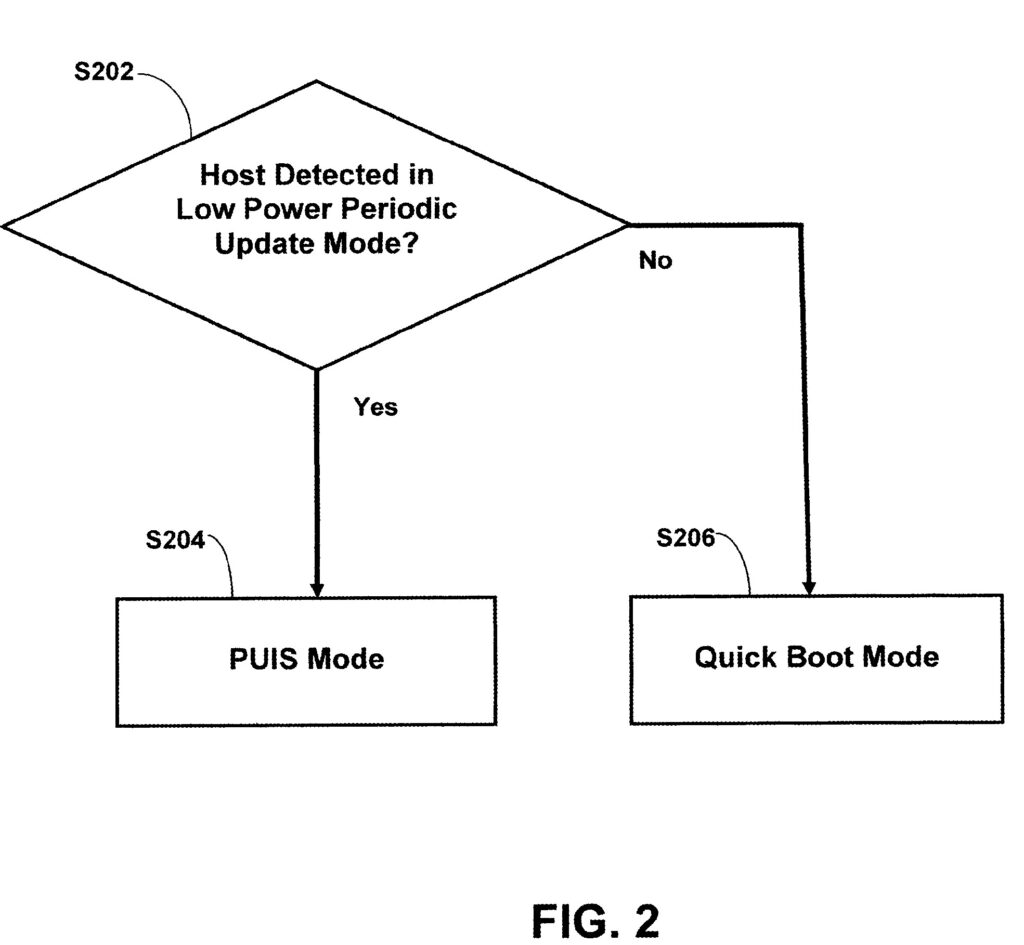
The present application concerns activating a “power up in standby mode” for a host’s non-volatile memory (e.g. its hard drive disc or solid state disc) when the host is detected to be in a “low power periodic update mode”.

WO_2015027117_A1

  • Claim 1 of the Main Request

Is it patentable ?

In the decision under appeal, the examining division held that the subject-matter of claim 1 lacked inventive step starting from document D1 (US 2012/042182 A1).

In the preliminary opinion, the Board considered that the feature of “placing the storage device in a power-up in standby mode” did not provide a technical effect as the claim did not specify that the storage device was in a different mode beforehand.

The applicant, amended the claim that the host was operable in active mode or low power mode, and the controller adjusted the storage device to power up in standby mode based on the determination of the host’s power-saving behavior, and argued as follows:

The appellant argued that the distinguishing features achieved the technical effect of adjusting the power-saving behaviour of the storage device to the host’s power-saving behaviour. The claimed solution was inventive since the skilled person would not have foreseen the claimed auto-detection of the host’s mode, nor would they have implemented this as a condition for placing the storage device in a “power up in standby mode”. The condition would notably ensure that the “power up in standby mode” was not activated when the host was in active mode, thus avoiding performance issues in that case.

Based on the amendments, the Board considered that the reformulated problem was technical and the skilled person would have no motivation to consider the problem, or have a hint towards the claimed solution, thus decided as follows:

The board holds that the distinguishing features achieve the technical effect of adjusting the power-saving behaviour of the storage device to the host’s power-saving behaviour, without affecting performance if the host is in active mode. The objective technical problem thus lies in how the system of document D1 can be modified such that the power-saving behaviour of the storage device is adjusted to the host’s power-saving behaviour, without affecting performance if the host is in active mode. Since document D1 neither mentions the host’s “low power periodic update mode” nor the disc’s “power up in standby mode”, the board considers that the skilled person would not have had any motivation to even consider the above problem. And even if they had, in the absence of any hint towards the claimed condition, it is not apparent that the skilled person would have arrived at the same solution as the inventors.

Thus, the board holds that, starting from document D1, the skilled person would not have arrived at the distinguishing features without employing inventive skills. Therefore, the subject-matter of claim 1 involves an inventive step over the disclosure of document D1.

Therefore, the Board decided that the subject-matter of the claims was inventive and remitted to the examining division with the order to grant a patent on the basis of the allowable claim of the Main Request.

More information

You can read the full decision here: T 0409/21 (Activating a storage’s “power up in standby mode” depending on the host’s power savings mode / WD) of May 4, 2023, of the Technical Board of Appeal 3.5.05

Stay in the loop

Never miss a beat by subscribing to the email newsletter. Please see our Privacy Policy.

Privacy policy
* = Required field

Input device with vibration parameters for providing a realistic sensation of operation: Technical

This decision concerns an invention related to input unit, which presents an operator with the same real feeling of pressing as the feeling of operating a push-button switch. The first instance considered the features defined by haptic signal and thus entailed a mere presentation of information. Although the applicant argued that by providing the ultrasonic vibration for a predetermined time and amplitude, the haptic effect provided a realistic sensation of operating a push-button switch, the Board disagreed as the claim was not limited, and thus the effect was not credibly achieved over the entire claimed range.

The applicant then amended the claim to include a specific numerical range of vibration time and amplitude. In this case, although the first instance decision considered them to be merely arbitrary values reflecting a subjective user preference, the Board sided with the applicant and agreed that the feature caused an effect of a “metal dome switch behavior,” and the parameters were only found after extensive experimentation. Thus the subject matter of the claim was not obvious.

Here are the practical takeaways from the decision T 1887/20 (Input device with load detection and vibration units / Kyocera) of March 3, 2023 of the Technical Board of Appeal 3.5.05.

Key takeaways

Providing vibration parameters to present an operator with the same real feeling of pressing as the feeling of operating a push-button switch is technical.

 Changing the frictional characteristics of the input unit provides the technical effect of defining a “metal dome switch behavior”, and as the parameters had been found by the inventors only after conducting extensive experiments, they were not obvious.

The invention

The application concerns an input apparatus that accepts input by pressing a touch panel and presents an operator with the same real feeling of pressing as the feeling of operating a push-button switch when the operator operates a pressing input unit.

  • Claim 1 of the Main Request

Is it patentable (Main Request)?

In the decision under appeal, the examining division held that the subject-matter of claim 1 differed from what was known from document D1 (D1 US 2007/236450 A1) in that the vibrations were set “for a predetermined time period with a predetermined vibration amplitude.” Based on this, the Board decided as follows

2.3 Inventive step (Article 56 EPC)

The examining division held that the distinguishing feature defined a haptic signal and thus entailed a mere presentation of information. Therefore, it could not contribute to an inventive step. In an auxiliary line of reasoning, the examining division considered that the distinguishing feature was obvious in view of document D1 (see D1, claim 26).

The appellant argued that the haptic effect provided by the invention solved the problem “to provide a realistic sensation of operating a push-button switch”.

The board considers that the technical effect argued by the appellant is not achieved over the entire claimed range. Notably, when operating a real push-button switch, only a short vibration is felt when pushing the button down. However, in claim 1, the “predetermined time” is not limited. Therefore, it also encompasses durations significantly longer than the time a push button is typically pressed, thus providing feedback even when the button has been released. Therefore, the board holds that the distinguishing feature does not credibly solve a technical problem and cannot thus contribute to an inventive activity.

Consequently, the board considers that the subject-matter of claim 1 is not inventive over the disclosure of document D1.

Is it patentable (Auxiliary Request)?

  • Claim 1 of the Auxiliary Request (II) - amendments highlighted

The Applicant amended the claims as follows:

Compared to claim 1 of the main request, the feature “to vibrate ultrasonically etc.” is amended to read as follows:

“to vibrate ultrasonically for a vibration time between 16 ms and 24 ms and with a predetermined vibration amplitude of 4 mym or more so as to generate a floating force on the pressing object to reduce a frictional force between the input unit (12) and the pressing object, wherein the predetermined criterion for accepting an input to the input unit (12) is 0.98 N or more and 2 N or less.”

The distinguishing features were identified as follows:

In the decision under appeal, the examining division held that the following definitions of the parameters constituted the distinguishing features over document D1:

– a vibration time between 16 ms and 24 ms

– a vibration amplitude of 4 mym or more

– a criterion for input acceptance of 0.98 N < Fin < 2 N

This was not contested by the appellant.

Thus, the board considers these features to constitute the distinguishing features over the disclosure of document D1.

The Board then decided on the inventive step, as follows:

4.2 Inventive step (Article 56 EPC)

In the decision under appeal, the examining division considered that the selected numerical values were arbitrary values reflecting a subjective user preference and thus not inventive.

The appellant argued that the distinguishing feature was technical since it related to changing the frictional characteristics of the input unit. Notably, it caused the technical effect of defining a “metal dome switch behavior”. The claimed parameters had been found by the inventors only after conducting extensive experiments and were thus not obvious.

The board considers the arguments of the appellant to be convincing. The board notes that document D1 discloses in paragraph [0127] a “pressure-dependent sensation for press confirmation” but does not give any details about the parameters for achieving it. Therefore, the board holds that although the skilled person could have implemented the invention as claimed, there is no motivation in document D1 for doing so.

Hence, the board considers that the invention defined in claim 1 according to the 2nd auxiliary request is not obvious in view of document D1 taken alone.

Therefore, the Board decided that the subject-matter of the claims was inventive. However, since the first instance had not examined the claims in light of other prior art document D3 to D5 which were cited in the proceedings, the board remitted the case to the examining division for further prosecution.

More information

You can read the full decision here: T 1887/20 (Input device with load detection and vibration units / Kyocera) of March 3, 2023 of the Technical Board of Appeal 3.5.05.

Stay in the loop

Never miss a beat by subscribing to the email newsletter. Please see our Privacy Policy.

Privacy policy
* = Required field

Increasing the robustness of a refinery by modelling: Technical

This decision concerns an invention related to product blending and component inventory management in an oil refinery by optimizing the shipping schedule and inventory constraints. The invention uses the nonlinear mathematical model, which simulates an ongoing refinery process taking into account initial values and cost parameters and minimizing the number of changes in the split ratio for a splitter and the sequence of blends.

The Board agreed that since the modeling is performed for an active refinery process in an actual refinery, feeding the model with the input parameters and direct conversion of the simulation results into output signals for the control of the blender and splitter in the refinery process can be considered technical inputs/outputs. According to G 1/19, these are indications of a “direct link with physical reality and of a “further technical effect” that goes beyond the mere technical implementation of the algorithm in a computer, and it is irrelevant whether the final step of implementing the optimization results is explicitly claimed as long as the skilled person understands from the wording of the claim that the simulation results are directly converted into control signals for the refinery.

Here are the practical takeaways from the decision T 1618/19 of February 28, 2023, of the Technical Board of Appeal 3.4.03.

Key takeaways

The feeding of the model with the input parameters as well as the direct conversion of the simulation results into output signals for the control of the blender and splitter in the refinery process can be considered technical inputs/outputs.

The feeding of process parameters of a running process into the simulation and the conversion of calculated process parameters into control signals are thus indications of a “direct link with physical reality and of a “further technical effect” that goes beyond the mere technical implementation of the algorithm in a computer.

It is irrelevant whether the final step of implementing the optimization results by means of control signals is explicitly claimed if the skilled person understands from the wording of the claim that the simulation results are directly converted into control signals.

The invention

The invention was summarized by the Board as follows:

1.1 The invention relates to product blending and component inventory management in a refinery. The objective of the product blending operations is to meet all the shipment commitments on schedule, while operating within the tank inventory constraints both for the blending components as well as the blended products. This operation should be executed in an optimal fashion in terms of overall cost and profitability. A multi-period blending optimisation system produces the optimum schedule for blending, along with optimum recipes and blended volume for each blend, while addressing the underlying inventory optimisation problem.

1.2 It is an alleged object of the invention to additionally minimise give-away losses (losses that occur when a premium quality product must be sold for the regular product price), to utilize better the most valuable components in higher quality products or as direct sales, thus increasing the net profitability of the refinery. A further objective is to realise a multi-period blending optimisation system that can optimise blending operations for components without storage tanks (see pages 1 and 2 of the application).

1.3 This is achieved by a nonlinear mathematical model which simulates an ongoing refinery process taking into account initial values and cost parameters (main request) and by minimising the number of changes of the split ratio for a splitter and of the sequence of blends (first auxiliary request).

Fig.4 of WO 2012/162141 A2
  • Claim 6 (computer-implemented method) of Main Request (labeling added by the Board)

Is it patentable?

The Board agreed with the applicant and considered the invention as overall technical:

3.1.1 The claimed subject-matter relates to a concrete apparatus, namely a blending control system in a refinery, and a corresponding method and is therefore overall undoubtedly technical.

3.1.2 Moreover, the claimed blending control apparatus/method comprises a computer modeling apparatus/method. The modeling is performed for an active refinery process in an actual refinery. The feeding of the model with the input parameters (flow and product parameters of the “rundown components supplied from the splitter” and refinery product commitments) as well as the direct conversion of the simulation results (“blend recipes”, “blend events”, “blend timing”, “split ratio”) into output signals for the control of the blender and splitter in the refinery process can be considered technical inputs / outputs according to G 1/19, OJ EPO 2021, A77, reasons 85, and are therefore technical or have a technical effect.

3.1.3 The feeding of process parameters of a running process, i.e. the refinery process, into the simulation and the conversion of calculated process parameters into control signals are thus indications of a “direct link with physical reality” (G 1/19, reasons 88) and of a “further technical effect” that goes beyond the mere technical implementation of the algorithm in a computer (G 1/19, reasons 91). Consequently, it is irrelevant whether the final step of implementing the optimisation results by means of control signals, i.e. to the splitter and blender, is explicitly claimed (as would be recommended in principle according to G 1/19), if the skilled person understands from the wording of the claim, in particular from features (A), (B), (H), (I), (K) and (L) in claim 1 and the corresponding features in claim 6, that the simulation results are directly converted into control signals of the splitter and blender. This is the case here.

3.1.4 Consequently, the entire subject-matter of claims 1 and 6 is considered technical.

The Board defined the problem as follows:

3.5 Effect and problem

3.5.1 The appellant defined the technical problem as “providing a blend control system that is more cost effective and provides a higher quality blend than the system in D5”.

3.5.2 In this regard, the board disagrees because the differing features do not improve the model, schedule, or blending process in D5. These features are not explicitly mentioned in D5 simply because the focus in D5 is not on the refinery process as such and the refinery infrastructure, but rather on the modeling, planning, and scheduling.

3.5.3 The board therefore defines the problem to be solved as implementing the model described in D5 in a realistic refinery infrastructure.

However, the Board considered that document D7 discloses a planning tool for a refinery comprising optimization of the blending and the blending schedule. Therefore, if the skilled person applies the modeling tool of D5 to a realistic refinery process, they would consider the refinery infrastructure of D7 and arrive at the subject-matter of the main Request.

Is Auxiliary Request patentable?

As an Auxiliary Request, the applicant then amended the claim as follows:

  • Claim 6 (computer-implemented method) of Auxiliary Request (amendments highligted)

The Board noted the distinguishing feature and the resulting technical effect as follows:

4.3.2 D5 fails to disclose:

(e) to encourage the sequence of blends to remain the

same from one optimization and the next

(f) to minimize the number of changes in the split

ratio for the or each splitter

4.4 Effect and problem

The effect of differing features (e) and (f) is independent from the effect of differing features (a) to (d). Features (e) and (f) have the effect of increasing the robustness of the blend schedule and blending system (page 17, lines 8 to 10). This applies to both the optimisation problem and the refinery infrastructure. Every change leads to additional risks and efforts, both in terms of timing, production downtime and additional personnel and material expenses. The additional partial problem to be solved may therefore be formulated as “increasing the robustness of the system and running the optimisation of the scheduling in a conservative manner”.

These features were considered inventive, as the conservative system for product blending and component inventory management in a refinery was non-obvious since it requires selecting specific parameters and introducing a damping mechanism to discourage changes between blends. Additionally, the claimed feature of keeping the sequence of blends unchanged from one optimization to the next was not suggested in any available state-of-the-art.

Therefore, the Board decided that the subject-matter of the claims was inventive.

More information

You can read the full decision here: T 1618/19 of February 28, 2023, of the Technical Board of Appeal 3.4.03.

Stay in the loop

Never miss a beat by subscribing to the email newsletter. Please see our Privacy Policy.

Privacy policy
* = Required field

Predicting travel time: non-technical

This decision concerns predicting travel time for passengers or baggage using statistical data analysis. The applicant argued that the statistical processing provides accurate/reliable future predictions. However, the Board considered that even if a statistical prediction model might involve a great deal of ingenuity, it pertains to the field of statistics applied to logistics planning which is not a field of technology. Since the prediction of a travel time is not a technical activity, a more accurate or faster prediction due to the prediction algorithm cannot be considered technical either, and so are any results thereof (e.g., accurate travel schedule) as the prediction does not affect a technical system or the physical travel process.

Here are the practical takeaways from the decision T 1148/18 (Travel process prediction/THE AQUA ENTERPRISE COMPANY) of December 15, 2022, of the Technical Board of Appeal 3.5.01.

Key takeaways

To identify the relevant factors and coming up with a statistical prediction model might involve a great deal of ingenuity and be far from trivial. This, however, pertains to the field of statistics applied to logistics planning which is not a field of technology as required by Article 52(1) EPC.

Normally, part of any statistical data analysis involves steps including mental or mathematical activities. It is a person skilled in the application of statistical mathematics to logistics planning, not a technically skilled person, that performs this kind of statistical analysis. Therefore, mathematical/statistical methods as such do not have technical character (Article 52(2)(a) and 52(3) EPC), and cannot contribute to inventive step.

Statistical calculations might provide accurate/reliable prediction results. This is, however, an inherent property of the calculations themselves and not a result of a particular implementation or the underlying technical system.

Prediction of a travel time is not a technical activity. Hence, a more accurate or faster prediction, in the sense of an enhanced speed of the prediction algorithm, can not be considered technical either. Also, any results thereof, e.g. a more accurate travel schedule, are not technical as the prediction does not affect a technical system involved in, and thus impacting on, the (physical) travel process.

The invention

The invention is a system that predicts travel time for passengers or baggage using scheduled flights. It compares passage time predictions for different flights, like flight A and flight B. The comparison uses statistical analysis of past travelers’ data, including their passage times through airport checkpoints and related flight information.

The system calculates average passage times, like arrival airport exit times, and performs a statistical test. Based on the test results, the user gets advice, such as “Make travel plan with sufficient time to spare.”

Fig. 15 of EP 2 662 259 A1
  • Claim 1 of Main Request

Is it patentable?

In the first instance, the Examination Division refused the European patent application on the grounds that the claims lacked an inventive step (Article 56 EPC).

The Board agreed with the Division and considered that due to the general wording of claim 1, a broad interpretation is used, and it was not inventive over general purpose computer system:

3. The Board judges that, regardless of the above, claim 1, in technical terms, defines a general purpose computer system which runs a software for implementing a non-technical concept, namely predicting a travel process or, more specifically, a travel time such as a duration of stay in an airport.

In light of the description the travel time depends on a number of (possibly interrelated) factors, for example airline schedules, passenger volume, weather conditions, entry formalities or customs/security handling. These factors are either of an administrative nature or a matter of logistics planning. They are, however, not based on technical considerations, for example regarding the operation of a technical system in the airport.

To identify the relevant factors and come up with a statistical prediction model might involve a great deal of ingenuity and be far from trivial. This, however, pertains to the field of statistics applied to logistics planning which is not a field of technology as required by Article 52(1) EPC.

In the Board’s view predicting a travel time based on historical data is conceptually similar to predicting arrival dates for delivery of mail based on previous delivery times (see T 0983/11 – Coordinated marketing/PITNEY BOWES, reasons, point 2.4) or predicting future purchases based on previous ones (see T 0977/17 – Storing electronic receipts/OTTO GROUP SOLUTION PROVIDER, reasons, point 2.2).

These are all activities excluded per se from patentability under Article 52(2)(a) and/or (c) and (3) EPC (cf. also T 154/04 – Estimating sales activity/DUNS LICENSING ASSOCIATES, reasons, points 19 and 20).

The Board considered the technical effect of the distinguishing features over a general-purpose computer system as follows:

4. Claim 1 differs from a general purpose computer system merely in the functions provided by the claimed means.

These functions essentially define the various aspects of statistics involved in predicting the travel time, i.e. data collection, organisation/storage, analysis, interpretation and presentation.

Specifically, they include:

– collecting (“specifying”, “acquiring”) and “storing” logistics (passage time, transportation specifying information) and statistical data (explanatory data comprising an explanatory text);

– receiving (“accepting”) user input (i.e. flight information and a specific passage point) to perform a comparative analysis;

– retrieving (“extracting”) historical data for the given user input and performing statistical calculations (“calculating”, “statistically testing”);

– providing (“extracting”, “outputting”) the results of the calculations and an explanation of the statistics.

First, these steps relate to mental or mathematical activities and are normally part of any statistical data analysis. It is a person skilled in the application of statistical mathematics to logistics planning, not a technically skilled person, that performs this kind of statistical analysis. Mathematical/statistical methods as such do not have technical character (Article 52(2)(a) and 52(3) EPC), and cannot contribute to inventive step.

Second, the output of the analysis is not used for a technical purpose. It merely supports the user in creating a (possibly more accurate) travel schedule – see paragraph [0130] of the application.

5. Under the COMVIK approach (see T 641/00 – Two identities/COMVIK) the above functions are, as they are part of the non-technical requirements specification, given to the skilled person within the framework of the objective technical problem to be solved.

The Board, therefore, considers that the skilled person, a computer programmer, faces the objective technical problem of implementing them in a general purpose computer system.

The computer implementation is obvious because it merely claims “means” for performing the various functions without any technical details.

The applicant argued that the features provide a technical effect of error processing. But the Board disagreed:

6. In the written procedure the appellant relied heavily on arguments concerning features not in the claim, for example regarding the operation and (error) processing of check machines.

The Board notes that the claims define the matter for which protection is sought (Article 84 EPC). Hence, they must be examined for compliance with the provisions of the EPC. In particular, technical features not present in the claims cannot support an inventive step argument and, thus, are not relevant for discussing inventive step.

7. The Board, however, agrees with the appellant that Figure 1 indeed shows a hardware architecture going beyond a general purpose computer system, but this is not reflected in the claim.

As mentioned above, the claimed “means” neither refer to specific hardware means (e.g. readers, servers, etc.) nor to a specific hardware/software configuration that could provide a further technical effect (cf. T 1173/97 – Computer program product/IBM, Headnote), e.g. by allocating functions to different system components.

The claim merely provides a functional definition of “means” and, thus, is not limited to any particular technical features. In other words, the means may be realised by simply programming the corresponding functions on a computer.

8. The statistical calculations might, as argued by the appellant, provide accurate/reliable prediction results. This is, however, an inherent property of the calculations themselves and not a result of a particular implementation or the underlying technical system.

9. In the Board’s view the prediction of a travel time is not a technical activity – see point 3 above. Hence, a more accurate or faster prediction, in the sense of an enhanced speed of the prediction algorithm, can not be considered technical either (see T 1954/08 – Marketing simulation/SAP, reasons, point 6.2).

Also, any results thereof, e.g. a more accurate travel schedule, are not technical as the prediction does not affect a technical system involved in, and thus impacting on, the (physical) travel process.

For the same reason also the appellant’s argument that using a large amount of (measurement) data and applying complex statistical calculations were not usual at the priority date of the application fails. These are, as outlined above, non-technical activities and can be included in the problem specification. Thus, for assessing inventive step it is irrelevant whether or not they were known in the prior art.

The applicant argued that the features provide a technical effect of feedback or self-learning system enabling more accurate/reliable future predictions. Again, the Board disagreed:

10. The appellant argued that storing explanatory data/text would provide a feedback or self-learning system enabling more accurate/reliable future predictions.

The Board cannot see that the explanatory data (see Figure 18) is in any way related to a feedback/learning loop for controlling a technical system. The purpose of the explanatory text is to explain to the layperson the results of statistics – see Figure 19. Such explanation neither represents technical data nor supports the user in performing a technical task. Thus, it cannot produce a technical effect (see T 1670/07 – Shopping with mobile device/NOKIA, reasons, point 13).

Therefore, the Board decided that the subject-matter of the claims was not inventive.

More information

You can read the full decision here: T 1148/18 (Travel process prediction/THE AQUA ENTERPRISE COMPANY) of December 15, 2022, of the Technical Board of Appeal 3.5.01.

Stay in the loop

Never miss a beat by subscribing to the email newsletter. Please see our Privacy Policy.

Privacy policy
* = Required field

Improving touch input using proximity touch: Technical

This decision concerns providing display control on a touch panel. In the first instance Examining division refused the application as it considered using distance and timing of the proximity touch input to was obvious.

The applicant argued that avoiding inadvertent actuation of the display due to unintended approach, thus reducing unwanted program steps and the user not being bothered by the display, is technical. The Board agreed and considered the feature improved the touch input and was inventive, as the cited document did not disclose the detection of a proximity touch based on a predetermined distance and time.

Here are the practical takeaways from the decision T 1756/20 (Proximity touch/SONY) of December 12, 2022, of the Technical Board of Appeal 3.5.05.

Key takeaways

Avoiding inadvertent actuation of the display due to unintended approach, thus reducing unwanted program steps and the user not being bothered by the display, is technical.

How to improve the touch input of the mobile terminal is a technical problem

The invention

Display (such as TV or music device) shows multiple channels simultaneously in a matrix format from which users can select using a remote. However, the remote control has many buttons for switching between channels and making selections, making it difficult for users to choose the desired channel and lowering usability.

The invention aimed to improve the selection by providing a device with a proximity detector that detects when a finger (or pen) is close to the screen displaying thumbnail images, which is then selected if the finger is in proximity for a time. In particular, a plurality of thumbnail images is displayed only when the proximity detector detects that the finger is in proximity to the display surface within a predetermined distance for a predetermined period.

EP 3 239 823 A1
Fig. 19 of EP 3 239 823 A1
  • Claim 1 of Main Request

Is it patentable?

In the first instance, the Examination Division refused the European patent application on the grounds that the claims lacked an inventive step (Article 56 EPC) in view of document D1 (EP 2 104 019) and common knowledge illustrated by document D5 (Microsoft: “Windows XP, Student Edition Complete” 1 January 2004).

The Board agreed with the applicant on the distinguishing feature over the closest prior art:

1.2 It was common ground in the oral proceedings before the board that D1 represented the closest prior art.

D1 discloses a mobile terminal with a touch screen, comprising a proximity detector (see paragraph [0094]) and a touch detector (see paragraph [0096]). As described in paragraph [0108] and illustrated in Figure 10, when the proximity detector detects a proximity touch to an item (e.g. “Sounds”) on the screen, a plurality of sub-items corresponding to the item are displayed (sub-items 1 to 6: “Hotel California”, …).

When the touch detector detects a touch on one of the plurality of sub-items, a function associated with the touched sub-item is performed (see paragraphs [0119] to [0126] and Figure 5).

1.3 The differences between claim 1 and D1 are in substance that:

a) in response to detecting the proximity of an indicator, the device displays a plurality of thumbnail images, as opposed to a plurality of sub-items in D1, each thumbnail having a reduced size and shape of an original launch image and being an indicant used for displaying the original launch image,

b) the display of the plurality of thumbnail images is terminated when one of the plurality of thumbnail images is selected with a touch,

and that

c) the plurality of thumbnail images is displayed only when the proximity detector detects that the indicator is in proximity to the display surface within a predetermined distance to the display surface for a predetermined period of time, instead of displaying the plurality of sub-items in D1 as soon as the indicator is within a predetermined distance.

Then the Board then considered the technical effect as follows:

1.4 The technical effect of feature c) is that a proximity touch is detected as such only if the indicator stays in proximity within the predetermined distance for a minimum duration, otherwise there is no proximity touch, and, as a consequence, no display of the plurality of thumbnails.

The appellant plausibly argued that a first advantage provided by feature c) is that the inadvertent actuation of the display due to unintended approach of the indicator (stylus or finger) at the required distance to the display is avoided. As a result, there is power saving since unwanted program steps, namely the display of the plurality of thumbnails, are not carried out. A further advantage is that a user deciding to input a real touch on a portion of the display surface is not bothered by the display of the plurality of thumbnails when its indicator (stylus or finger) approaches the display surface, since the display of the thumbnail images is not started as long as the indicator is in proximity but the predetermined time is not yet reached.

The objective technical problem can thus be formulated as being how to improve the touch input of the mobile terminal of D1.

The Board then decided that the feature was inventive as D1 did not disclose the detection of a proximity touch or the speed used to detect a proximity touch. Therefore, the skilled person could not have obtained any teaching about proximity touch detection based on a predetermined distance and a predetermined time from the cited document.

Therefore, the Board decided that the subject-matter of claims is technical and inventive.

More information

You can read the full decision here: T 1756/20 (Proximity touch/SONY) of December 12, 2022, of the Technical Board of Appeal 3.5.05.

Stay in the loop

Never miss a beat by subscribing to the email newsletter. Please see our Privacy Policy.

Privacy policy
* = Required field