Author Archive

Machine learning-based driver alertness detection: insufficiently disclosed

In this decision, the European Patent Office did not grant a patent on a machine learning-based driver alertness detection system. Here are the practical takeaways of the decision T 0509/18 of 3.3.2020 of Technical Board of Appeal 3.2.01:

Key takeaways

No mathematical methods and corresponding criteria allowing to handle said matrix and obtain a “look-up-table classification” are disclosed or even suggested in the description.

The invention

This European patent application generally relates to a monitoring system to monitor the alertness of a driver and issue a warning if it is determined that the driver is distracted for a sufficient period.

Fig. 1 of EP 2 688 764

Here is how the invention is defined in claim 1:

  • Claim 1 (third auxiliary request)

Is it patentable?

The first-instance examining division had refused the patent application based on lack of novelty. After the applicant had filed a new main request and a series of auxiliary requests on appeal, the board of appeal still concurred with the examining division, and in addition took raised an objection under Art. 83 EPC (disclosure of the invention).

According to the board, the central feature of the claimed driver alertness detection system was that “the driver alertness detection system is configured to use a classification training process to register the driver’s head position and eye vector for the A-pillars, instrument panel, outside mirrors, rear view mirror, windshield, passenger floor, center console, radial and climate controls within the vehicle, and configured to save a corresponding matrix of inter-point metrics to be used for a look-up-table classification of the driver’s attention state, the inter-point metrics being geometric relationships between detected control points and comprising a set of vectors connecting any combination of control points including pupils, nostrils and corners of the mouth”.

But the board took the view that the application did not disclose the invention in a manner sufficiently clear and complete for it to be carried out by a person skilled in the art:

In the Board’s view the definition of claim 1 and the corresponding passages in the patent application (WO-A) do not teach the skilled person how a “look-up-table classification of the driver’s attention state” is to be obtained by the skilled person, based on said “matrix of inter-point metrics”, the inter-point metrics representing “geometric relationships between detected control points and comprising a set of vectors connecting any combination of control points including pupils, nostrils and corners of the mouth”.

In particular, WO-A does not teach how to derive from said “matrix of inter-point metrics” a “look-up-table classification of the driver’s attention state”, such a “look-up-table classification” permitting to decide on the driver’s attention state. A “matrix of inter-point metrics” being a mathematical object representing a set of “geometrical relationships between detected control points” according to WO-A (and to claim 1), a specific mathematical method and corresponding criteria (or algorithms) necessarily have to be determined in order to be able to handle said matrix and to deal with said matrix. No such mathematical methods and corresponding criteria allowing to handle said matrix and obtain a “look-up-table classification” are disclosed or even suggested in the description of WO-A. In addition, the actual specific form and construction of said “matrix of inter-point metrics” is likewise not specified in WO-A. Therefore the skilled person would not know how to construct a “look-up-table classification” and consequently how to decide on the driver’s attention state based on the video camera’s image of the actual position of driver’s head and eyes at a given instant.

In addition, claim 1 and WO-A likewise do not teach how a video camera’s image representing the instant position of a driver’s head and eyes (as seen e.g. in figures 8A, B or C) should be actually compared with a hypothetical “look-up-table classification” in order to assess the driver’s attention state. In effect, this step requires instructions and teaching concerning the kind of information to be extracted from a given video camera image and concerning the method and the criteria (similarly as above) to be applied in order to compare this information with the information included in the hypothetical “look-up-table classification”. No such disclosure is to be found in the description of the patent application (WO-A).

The same conclusions apply a fortiori to claim 1 of the main, first and second auxiliary request, since the subject-matter of each of these claims includes only part of the features of claim 1 of the third auxiliary request, thus including even less information than is included in claim 1 of the third auxiliary request.

The board hence concluded that the application did not disclose the invention in a manner sufficiently clear and complete for the skilled person to be able to carry out e.g. a “classification of the driver’s attention state”. The appeal was dismissed.

More information

Stay in the loop

Never miss a beat by subscribing to the email newsletter. Please see our Privacy Policy.

Privacy policy
* = Required field

Determining the value of a collateral using an index value calculated based on an appraised quality/quantity of water: non-technical

This is a further decision that confirms that business-related aspects of the claimed subject-matter cannot contribute to inventive step. Here are the practical takeaways from the decision T 0426/16 of 17.9.2020 of Technical Board of Appeal 3.4.03:

Key takeaways

Remember that the so-called “contribution approach”, taking into account prior art when determining whether subject-matter was excluded under Art. 52(2) and (3) EPC 1973, is abandoned (Case Law of the Boards of Appeal of the European patent office, I.A.1.4.1 a) and b)

It must be clear from the wording of the claim or the application that technical means must actually be used to carry out a method step.

The invention

The invention underlying the present decision relates to an investment instrument for water based on a stable free market price. A broker computes an index value of water 104 (1.07 $ per m3, for example), which allows to evaluate a defined portion of the body of the water. Then, the broker may sell a certificate for 1000 m3 of water for 1000 m3 x 1.07 $/m3 = 1070 $ (plus, for example, a 2% commission) to an investor. The relevant factors for computing the value index of the water are regularly updated. Furthermore, the state of a collateral is periodically appraised by a “professional appraiser” and the value of the collateral adjusted in order to make sure that each certificate is covered by valid assets.

Fig. 1 of WO 2009/024928 A2

Here is how the invention was defined in claim 1:

  • Claim 1 (main request)

Is it patentable?

At the end of the first instance prosecution stage, the examining division decided that the subject-matter of the independent claims of the main request (and of first to third auxiliary requests) lacked an inventive step in view of a notoriously-known computer network system. In more detail, most of the claimed features were ignored for the assessment of inventive step since they were considered non-technical:

4.1 The examining division decided that the subject-matter of the independent claims of the main request and of the first to third auxiliary requests, all filed on 10 August 2015, lacked an inventive step (Article 56 EPC) in view of a notoriously known computer network system. The technical features of the method claim 1 of the requests were no more than a notoriously known “computerized system”, see sections 12.3 and 12.4 of the contested decision. The step of “professionally appraising fresh water in regard to the quality and quantity”, the steps of determining and repetitively updating an index value (based on changes on the price of a product, the quantity of water utilized to produce the product and the quantity of water constituent in the product) and the step of determining a value of the collateral using the computed index value and the appraised quality/quantity of the collateral were considered as related to “a business concept on an abstract level”, see sections 12.2.

Against this decision, the applicant filed an appeal and argued that a water quality appraisal instrument is a technical means (hereinafter first argument). In addition, the applicant argued that, according to some decisions of various Boards of Appeal, in order to be patentable, it is sufficient that the claimed subject-matter is based on technical considerations (hereinafter second argument):

(d) According to the appellant, the claims recited a non-abstract technical solution with a technical character and, hence, provided a technical solution to a technical problem. In view of the “professional water quality appraisal instruments” in the independent claims, the skilled person was “an expert in the field of technical evaluation of substances in the water by technical instruments”, which “could not be interpreted as an abstract mental or pure business act that can even be performed by a human being”. Features (b) and (b’) therefore were technical features. As examples of an “professional water quality appraisal”, the appellant mentioned the measure of the amount of one or more substances in water e. g. to determine its salinity or its pH, the term “water quality” being a known “technical characteristic”. The appellant cited a number of web pages related to the testing of water quality.

(e) The appellant argued that the “water quality appraisal instruments” were “integrated together with the inventive combination of elements” according to features (h) and (n) or (h’) and (n’), because for determining the “value of a defined portion of the amount of water” the first (or second) index and the appraised water quality (category) were taken into consideration.

(g) The appellant mentioned decisions T 931/95 and T 769/92, where the Board of Appeal held “allowable a method claim based merely on an implied need for technical considerations”. The Board in case T 769/92 found that the invention had technical character because it implied a need for technical considerations when carrying out that invention.

However, the board in charge did neither follow the first nor the second argument. With respect to the first argument, the board argued:

No indication can be found in the application as originally filed for “professional water quality appraisal instruments” according to features (b) and (b’). “Professional water quality appraisal instruments” are neither explicitly mentioned on page 6 nor can they be derived therefrom. Page 8, lines 9 to 10, lines 17 to 22 and figure 2, box 236 merely mention that a “professional appraiser appraises (box 236) the collateral for the quantity, the quality and availability of the water”. From this passage, a skilled person reading the application as originally filed cannot directly and unambiguously derive that “professional water quality appraisal instruments” are involved or what kind of analysis (salinity, pH or other) is performed. The Board understands from page 8, lines 17 to 24 that step 236 in figure 2 concerns an evaluation by a professional of the state of the collateral 101, e. g. a lake. However, no indication can be found in the application that this evaluation requires any “professional water quality appraisal instruments”.

[…]

Hence, the application as originally filed does not disclose “water quality appraisal instruments” as such or does not suggest that the professional appraisal mentioned on page 8, lines 17 to 22 is necessarily performed by using technical means.

On the second argument, the board in charge commented as follows:

4.6 Regarding the appellant’s comments on T 769/92, see section VII., point (g), the Board notes that this decision concerned the question whether the claimed subject-matter was covered by the exclusion provisions of Article 52(2) and (3) EPC and still followed the now abandoned “contribution approach”, see e. g. Case Law of the Boards of Appeal of the European patent office, I.A.1.4.1 a) and b). A discussion of the contribution approach and the departure from it can be found e. g. in G 3/08, points 10.6 and 10.7 of the Reasons for the Opinion. In the present case, the examining division did not question that the subject-matter of the claims was not falling within the exclusions of of Article 52(2) and (3) EPC. Furthermore, the Board in T 769/92 found that technical considerations were necessary before programming of the computer-implemented method could begin. In the present case, no technical considerations are to be made, as each consideration appears to be made by a broker, and not a computer engineer.

4.7 Hence, in view of sections 4.3 to 4.6 above and of the example of figures 1 to 3, the Board is of the view that the only technical features disclosed in the application as a whole and present in the above subject-matter are a notoriously-known computer with a processor, a memory and a display. As a side remark, the Board notes that a basis for a method involving or a system having plural computers, plural processors or plural display devices is not disclosed in the application as originally filed, figure 1 only showing one desktop computer with a processor, a memory and a display device.

Therefore, the board concluded that claim 1 of the main request did not involve an inventive step. Furthermore, since the same arguments would also apply to the subject-matter of all filed auxliary requests, the appeal was dismissed.

More information

You can read the whole decision here: T 0426/16 of 17.9.2020

Functional implementation of a lottery game: non-technical

This decision is a good reminder that the technical implementation of an otherwise non-technical method has to be rather specific to be patentable. The more high-level and functional the implementation is claimed, the lower the chances of success at the EPO. 

Here are the practical takeaways from the decision T 0886/14 (Lottery game/Al-Ziyoud, Aiman H.) of 16.11.2020 of Technical Board of Appeal 3.5.01:

Key takeaways

The technical implementation is only claimed in functional terms and there are no details of how it is actually achieved. Hence, at the level of detail of claim 1, the advanced effects of reducing latency and redundancy are not further technical effects which could give rise to an objective technical problem.

The invention

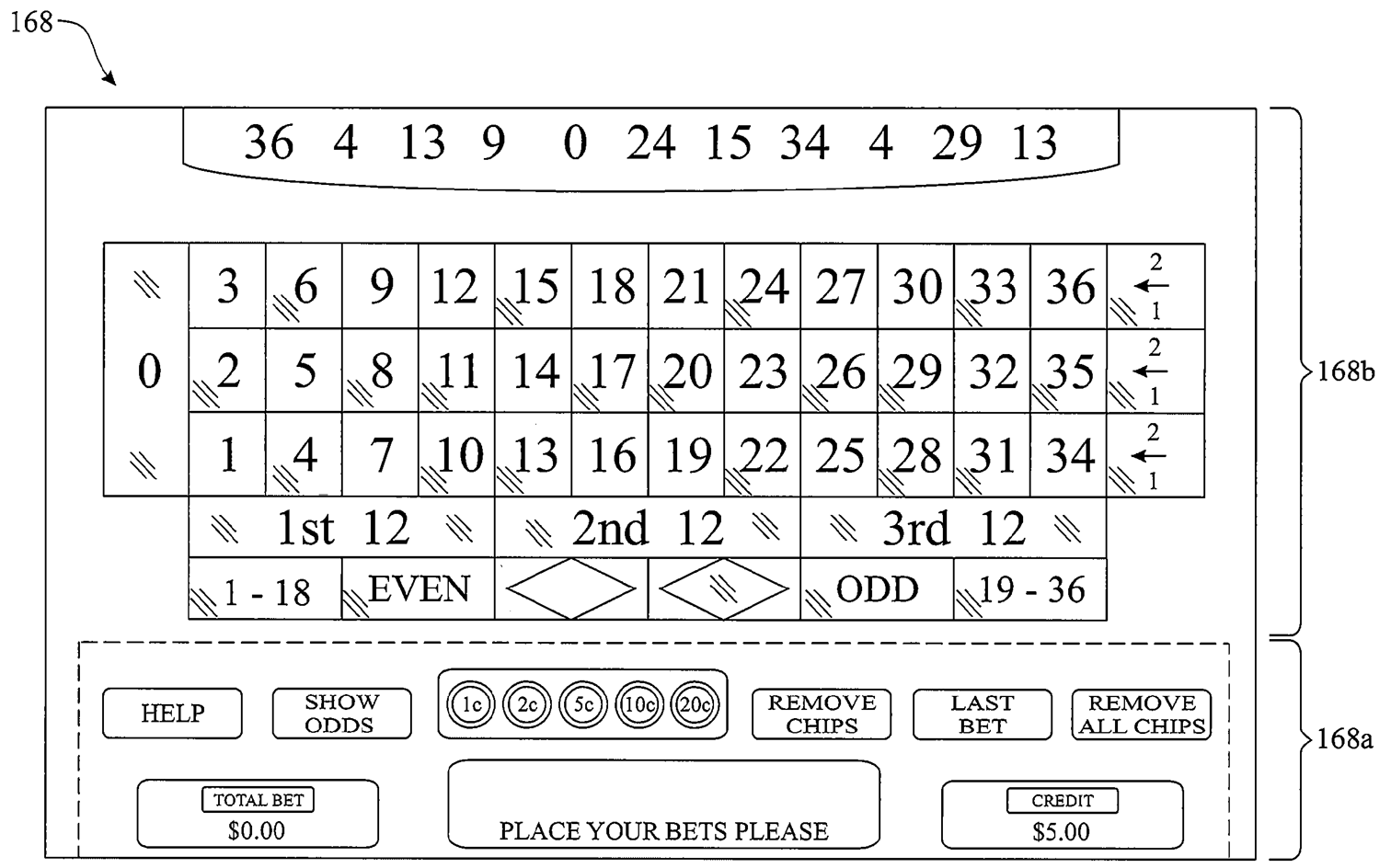
This European patent application concerns a system for playing a lottery game with a progressive accumulative jackpot. The jackpot grows with each lottery ticket because a portion of the purchase price goes into the jackpot.

The lottery system described in the application comprises a central lottery system connected to a number of remote communication devices via a public telecommunications network:

Fig. 1C of EP 1 623 375

The players use their communication devices to request lottery tickets from the central lottery system. The central lottery system comprises an input terminal, e.g. a web server, for receiving the request from the remote communication device, a central server, and a database for storing the jackpot size.

Having received the ticket request, the central lottery system assigns the requested number of lottery tickets to the player and bills him. Next, the system updates the jackpot size in the database by adding to the jackpot (a portion of) the price of the purchased tickets. The updated jackpot amount is then provided to the central server, which transmits it to a presentation device for display.

Here is how the invention was defined in claim 1:

  • Claim 1 (main request)

Is it patentable?

The first-instance examining division had refused the application for lack of inventive step. The argument was that claim 1 then on file addressed the problem of defining rules for playing a game, automation of administrative methods, and presenting information, whereas the implementation of these aspects included only the use of conventional computing components.

The board of appeal agreed with the examining division that a conventional client/server system was an appropriate starting point for assessing inventive step in this case. Claim 1 was found to differ from a conventional client/server system in that

  • the server receives, from the remote client, one or more lottery purchase orders,
  • stores the accumulated jackpot amount (“latest lottery prize amount” in claim 1),
  • updates the jackpot amount automatically based at least partially on the received lottery purchase price, and
  • provides the updated jackpot value to a presentation device automatically when the jackpot value has been updated.

According to the appellant, the claim defined an asymmetric information path between a user and the server. The user inputting the lottery purchase order to the server did not receive the latest jackpot amount; the jackpot amount was instead broadcast to prospective users via television, radio, or a website. This was a difference over the conventional client/server system where data exchanged between a client and a server always followed a symmetrical path. But the board did not follow this argument:

In the Board’s view, however, the claim does not exclude that the remote communication device and the presentation device is one and the same device. Indeed, according to the application (see page 12, lines 21 to 22 and lines 25 to 26), the presentation device can be a computer device providing displaying capabilities.

In any case, the presentation is not limited to television, radio, or a website. Furthermore, the claim wording covers not only broadcast but also unicast and multicast. Therefore, the Board does not agree that the alleged asymmetry is present in claim 1.

Irrespective of this finding, the board also noted that the requirement that the jackpot value be provided to all players, including prospective players, is a non-technical one:

Like the examining division, the Board takes the view that the claimed subject-matter aims at implementing a method for playing a lottery game, which, when taken as such, would be excluded from patentability pursuant to Article 52(2)(c) and (3) EPC.

The non-technical method of playing a lottery game comprises:

– One or more players request and purchase one or more lottery tickets.

– The lottery is organised by a lottery organiser.

– The lottery scheme includes adding a portion of the purchase price to an accumulative jackpot.

– Each time the jackpot value is increased, it is immediately notified to the requesting lottery player or all lottery players.

Under the COMVIK approach (see decision T 641/00) the non-technical features cannot contribute to inventive step.

The appellant argued that the invention produced a number of technical effects. For example, the server transmitted only the updated jackpot value which avoided a wasteful and redundant transmission of values that have already been transmitted. Furthermore, the server provided the updated jackpot value in real-time and not following some delay. As a result, the technical effect of reducing latency in data transmission was provided. But also these arguments did not succeed:

The Board considers, however, that the effects advanced by the appellant are not (further) technical effects counting towards inventive step. The non-technical method includes that a jackpot value should be provided without delay when it is updated. It follows that the effects advanced by the appellant result from the lottery method per se rather than from its technical implementation. The technical implementation is only claimed in functional terms and there are no details of how it is actually achieved. Hence, at the level of detail of claim 1, the advanced effects of reducing latency and redundancy are not further technical effects which could give rise to an objective technical problem. Furthermore, any asymmetric information exchange would also be a direct result of the non-technical requirement that the jackpot value should be provided to all players.

The Board notes that this finding is in line with the established case law represented i.a. by decision T 258/03 (see points 5.6 to 5.7 of the reasons) and decision T 172/03 (see point 22 of the reasons).

In the appellant’s opinion, the objective technical problem was how to provide a platform for the implementation of a lottery capable of providing both participants and prospective participants real-time data about the jackpot total. The Board considered, however, that this problem was not correct …

… as, contrary to the COMVIK-principle, it does not comprise all parts of the above non-technical method for playing a lottery game. In line with the COMVIK-principle, this method cannot contribute to inventive step and is instead provided in its entirety to the technically skilled person as part of the framework of the objective technical problem. Hence, in the Board’s judgement, the skilled person faces the objective technical problem of implementing the lottery method on the conventional client/server system.

Furthermore, the Board considered that the claimed implementation would have been obvious to the skilled person facing the above problem:

In particular, it would have been obvious to implement the lottery game functionality including maintaining and updating a jackpot at the central server. Indeed, it is already given as part of the game rules that the lottery is organised centrally. It would also have been obvious to implement functionality for requesting tickets at client computers connected to the server; this could be done for example using web page forms provided from the server to the remote devices. Finally, providing the jackpot value to all participating players could be straightforwardly accomplished for example by sending automatically generated emails to all players’ client computers and by displaying their content.

The appellant also argued that it would not have been obvious at the priority date to present the exact value of the updated jackpot, because lottery systems known at that time rather presented an estimated jackpot amount. But also this argument was not successful:

However, the question whether the skilled person would consider notifying the exact value of the updated jackpot to players in real-time does not arise here, because that has already been decided in formulating the objective technical problem. Therefore, the skilled person would seek to provide such functionality because the problem requires him to do so regardless of whether lottery schemes adopted this solution at the priority date or not. The only question is how it would be done, but, as outlined above, the Board considers the claimed implementation to be obvious.

Therefore, the board concluded that claim 1 did not involve an inventive step, and dismissed the appeal.

More information

You can read the whole decision here: T 0886/14 (Lottery game/Al-Ziyoud, Aiman H.) of 16.11.2020

Stay in the loop

Never miss a beat by subscribing to the email newsletter. Please see our Privacy Policy.

Privacy policy
* = Required field

Summarizing unformatted documents: non-technical

In this decision, the board of appeal made clear that a non-technical feature in a claim does not automatically inherit the technical character of the context in which it occurs.

Here are the practical takeaways from the decision T 0483/11 (Document summary/ARIZAN CORPORATION) of 13.10.2015 of Technical Board of Appeal 3.5.01:

Key takeaways

A feature does not automatically inherit the technical character of the context in which it occurs. The feature must, itself, make a contribution to the technical context or the technical aspects of the invention.

The invention

At the date of the invention, mobile data connections were slow and mobile devices had limited processing and display capabilities. But at the same time, electronic documents were large and contained “rich” content. The core of the invention was thus to create a smaller summary version for an electronic document.

The summary is generated by a server in response to a request from a mobile communication device and is transmitted to the mobile device. The user can use the summary to navigate the electronic document and request content corresponding to the summary entries from the server. This precludes the need to send the entire document to the mobile device, at least initially.

The server generates the summary by selecting content from the electronic document. It does this using one of three processes:

Fig. 3 of EP 1 573 562
  • If the document has so-called “content structure”, e.g. a table of contents, this information is used as a summary (“structured document summarization process”).
  • If the document does not contain such information, any text formatting or paragraph formatting is analysed in order to find “section identifiers” (headers and titles) in the document which are used as summary entries (“unstructured document summarization process”).
  • If the document contains neither “predetermined content structure” nor text or paragraph formatting information, or if all the text is formatted identically, the process operates on the basis of differences in paragraph size: shorter paragraphs (those having few characters) are more likely to be section identifiers than longer paragraphs (“unformatted document summarization process”).

Here is how the invention was defined in claim 1:

  • Claim 1 (main request)

Is it patentable?

The first-instance examining division had refused the application for lack of inventive step based on the argument that claim 1 essentially related to a computer-implementation of a non-technical method.

On the appeal stage, the Board took the view that the only difference between claim 1 and the closest prior art was the “unformatted document summarization process” for extracting summary information based on differences in paragraph size.

The patent applicant had argued that the claimed document summarization was technical, because it was part of a technical context, i.e. a mobile communication system. Secondly, the summarization was provided to overcome the technical limitations of such a system. The “unformatted document summarization process”, in particular, was technical for those same reasons. It allowed a larger class of documents to be summarized and used in the context of the mobile communication system.

The board acknowledged that the invention had technical character as a whole, but doubted that the document summarization process provided a technical contribution that would be relevant for inventive step under the COMVIK approach:

2.7 In the present case, the contribution of the invention does not lie in the use of document summarization in a mobile communication system. That is already in the prior art. The contribution lies rather in the algorithm for extracting summary information from the electronic document, more specifically in the manner in which section identifiers are assumed in a text that has no differences in formatting. In the Board’s view, this is not technical. It is a mental act, such as would be performed by a human when reading a text.

2.8 Put in the technical context of the mobile communication system, the unformatted document summarization has the consequence that a larger class of documents can be summarized. However, the Board does not consider this to be a technical effect. The Board does not share the appellant’s view that a feature automatically inherits the technical character of the context in which it occurs. The feature must, itself, make a contribution to the technical context, or the technical aspects of the invention.

Therefore, the board took the view that the “unformatted document summarization process” did not make a technical contribution over the prior art. The board further considered that the implementation of this functionality would have been straightforward, using routine programming methods. Thus, the board concluded that claim 1 did not involve an inventive step, and dismissed the appeal.

More information

You can read the whole decision here: T 0483/11 (Document summary/ARIZAN CORPORATION) of 13.10.2015

Stay in the loop

Never miss a beat by subscribing to the email newsletter. Please see our Privacy Policy.

Privacy policy
* = Required field

Estimating the availability of a person despite inaccurate calendar information: non-technical

This decision is a good example of a software tool with very useful functions for the modern office worker, but which does not necessarily qualify as a patentable invention at the European Patent Office.

Here are the practical takeaways from the decision T 0434/13 (Generating availability data of a called party/MITEL) of 26.1.2017 of Technical Board of Appeal 3.5.03:

Key takeaways

Providing a more reliable estimate of availability in order to overcome the drawback that not all users provide accurate updated information in their calendars is not a technical problem.

The invention

This European patent application concerns context-aware call handling in communication systems.

According to the application, it is commonplace for users of telephone systems to be directed to voice mail when they attempt to reach a potential collaborator. The calling party can leave a message requesting to be called back, but there is no assurance that the calling party will be available when the called party makes the requested return call. The familiar game of “telephone tag” is created in this way.

But moreover, so the application, social science research has indicated that informal interaction is an essential element of workplace life to provide for both innovation and efficiency. To this end, the telecommunications industry has been developing presence and availability technology to provide for the necessary element of causal awareness. These allow users to share their current availability with potential collaborators. However, knowledge of current availability is not useful when the called party is not available and the parties need to communicate with each other.

The application therefore regards it as a key aspect of the invention to integrate availability indicators to decisions on call disposition by
call control. In particular, it proposes a method for improving the estimation as to the likely availability of a user to which a call may be made in the future from a calling party.

Fig. 8 of EP 2 071 816

Here is how the invention was defined in claim 1:

  • Claim 1 (main request)

Is it patentable?

The first-instance examining division had refused the application for lack of inventive step based on the argument that claim 1 essentially related to a computer-implementation of a non-technical method.

In its inventive-step assessment on the appeal stage, the board identified the following distinguishing features over the closest prior art:

The subject-matter of claim 1 therefore differs from the disclosure of D1 in that claim 1 includes the following features:

said estimating availability for said at least one future temporal block comprises a hardware or software confidence agent querying a calendar of at least one other user associated with said user to determine meetings in which said user may be involved,

estimating confidence of said queried calendars by querying an estimator that monitors actual meeting information of a user associated with said queried calendar,

comparing said actual meeting information with meeting information recorded in said queried calendar, determining the proportion of accurately recorded meeting information with respect to a total amount of meeting information recorded, and

giving preference to meetings associated with the queried calendar having the highest confidence when applying said availability rules.

Following the COMVIK approach, the board assessed whether these features produce any technical effect and thus contribute to the solution of a technical problem. The avid reader will probably have guessed the board’s answer:

In the board’s view, the main (non-technical) problem to be solved starting out from D1 is to provide a more reliable estimate of availability in order to overcome the drawback that not all users provide accurate updated information in their calendars. This problem is essentially solved by consulting calendar information (data entered by the user as well as “actual” meeting information) with regard to meetings of a user and at least one other user associated with the user, and giving preference to meeting information determined to have a higher likelihood of accuracy based on comparing actual meeting information with recorded calendar information. This concept is essentially non-technical (although this was disputed by the appellant, see below), since neither calendar data, nor “actual” meeting data, nor availability estimate data have any technical character, and the manipulation of the data to determine the estimate concerns essentially a mathematical method, which is also regarded as non-technical (cf. Article 52(2)(a) EPC).

The patent applicant had argued that providing improved availability data indeed resulted in technical effects, because improved availability data reduced the use of communication resources between a calling party and a called party and enhanced the call processing options available. As the improved availability assessment was responsible for these effects, all features of claim 1 contributed to inventive step.

But the board was not persuaded:

The board however considers that the presence of the wording “for a future communication from a calling party” makes no contribution to inventive step. In this respect, consider that a caller in a conventional manner wished to place a call to a called party. When deciding whether to place the call at a certain time, it is obvious that it would be possible to obtain information regarding the called party’s likely availability during a particular period of time, for example by consulting the person’s diary or calendar, as well as other calendars indicating meetings which the person is scheduled to attend. Determining a person’s availability in this way is essentially non-technical. The mere fact that the improved result might potentially be used to influence when to place a future conventional call to that person does not in itself give the method a technical character. It is further noted that the wording “for a future communication” does not even require in claim 1 that a future communication be made. Consequently, this hypothetical step does not meaningfully limit the claim.

Accordingly, the board considered the features in question to be non-technical features, so that they do not contribute to inventive step under the COMVIK approach. The board then went on to assess whether the claimed computer-implementation could involve non-obvious further technical considerations. The patent applicant had argued that the computer-implemented solution using a confidence agent and an estimator for monitoring actual meeting information went beyond merely carrying out non-technical steps on a computer. But the board did not agree:

The board however disagrees. In this respect, the board considers that the skilled person wishing to solve the problem of implementing the availability estimation (cf. point 1.5 above) would, without requiring inventive skill, provide the “normal” hardware and/or software entities necessary for (i) obtaining the required data from calendars (e.g. by querying on-line calendars), (ii) obtaining data concerning actual meeting information (e.g. by querying a store of such information), and (iii) estimating availability by comparing the data in the manner claimed. With regard to the features “confidence agent” and “estimator” in claim 1, the board considers that “confidence agent” is merely an arbitrary term for a software entity which carries out steps (i) to (iii), and the term “estimator”, while obscure, since this component does not appear to estimate anything, but merely “monitors” actual meeting information, is understood as a hardware and/or software entity programmed to be supplied with actual meeting information data, and which can be queried by the confidence agent. The board considers that it makes no difference to the assessment of inventive step whether the confidence agent itself “monitors” the actual meeting information data (see point (ii) above), or whether this task is performed by a separate hardware and/or software module which has to be queried by the confidence agent. The functional and/or physical separation of such programming tasks is a routine measure for the skilled person, as illustrated by D1, in which different entities are involved in collecting presence information (“presence server 114”), collecting calendar information (“calendar server 118a”), and analysing the information (“rules engine 112”).

The board therefore concluded that claim 1 did not involve an inventive step, and dismissed the appeal.

More information

You can read the whole decision here: T 0434/13 (Generating availability data of a called party/MITEL) of 26.1.2017

Stay in the loop

Never miss a beat by subscribing to the email newsletter. Please see our Privacy Policy.

Privacy policy
* = Required field

Necessity of stopping a suspicious vehicle: non-technical

The EPO considered determining whether a suspicious vehicle needs to be stopped to detect a toll offence is a legal requirement and thus non-technical. Here are the practical takeaways from the decision T 0595/16 (Kontrollbedüftiges Fahrzeug/TOLLCOLLECT) of 14.9.2020 of Technical Board of Appeal 3.5.05:

Key takeaways

Assigning vehicles to different groups based on specific criteria in order to decide whether a vehicle has to be checked manually is a business-related method and thus not technical.

The invention

This European patent application underlying the present decision relates to a control method for road toll collection using a control system. Every vehicle on every road section that is monitored by the system is to be checked by collecting usable vehicle information. Based on these information, it is decided whether suspicious vehicles are stopped and checked manually by inspection staff (cf. WO 02/061690 A1, pages 1-3).

Fig. 5 of WO 02/061690 A1

Here is how the invention was defined in claim 1:

  • Claim 1 (main request) - translated from German into English by the author of this post

Is it patentable?

The first-instance examining division rejected the application due to lack of inventive step in light of prior art document D4. Independent claim 1 of the rejected application differs from the teaching of D4 in that control data of a vehicle subject to checks are not transmitted to a control center but to a control point. According to the application, a control point is a checkpoint where control staff performs manual inspections of vehicles. However, the first-instance examining division considered this distinguishing feature to be non-technical and argued that the necessity of stopping a suspicious vehicle to conduct a further manual control is considered a legal requirement, but not a technical one. Hence, the distinguishing feature was not considered for the assessment of inventive step (cf. point 1.4 of the appeal decision).

During appeal stage, the applicant further argued that assigning the vehicles to be checked into different case groups as specified by claim 1 would be technical (cf. point 1.5 of the appeal decision). In more detail, it would be technical to change the number of vehicles that need to be checked by assigning them to different groups which are then used to decide whether a vehicle is manually checked or not.

However, the board in charge did not follow these arguments and argued that assigning vehicles to different groups is a business-related method to control the number of vehicles to be checked, as for example outlined in the  description in the sentence bridging pages 30 and 31. Hence, also the feature of claim 1 referring to the case groups is considered non-technical and thus not relevant for assessing inventive step.

As a result, the board in charge came to the conclusion that D4 renders-obvious the claimed subject-matter and dismissed the appeal.

More information

You can read the whole decision here: T 0595/16 (Kontrollbedüftiges Fahrzeug/TOLLCOLLECT) of 14.9.2020

Stay in the loop

Never miss a beat by subscribing to the email newsletter. Please see our Privacy Policy.

Privacy policy
* = Required field

Improving a mobile POS terminal in respect of the customers’ security against fraudulent use of their sensitive information: technical

This decision is interesting in that it uses the concept of the “notional business person”, as it was introduced in T 1463/11, to assess whether a given difference over the prior art achieves a technical effect or not.

Here are the practical takeaways from the decision T 1749/14 (MOBILE PERSONAL POINT-OF-SALE TERMINAL/MAXIM) of 3.4.2020 of Technical Board of Appeal 3.5.01:

Key takeaways

Improving a mobile POS terminal in respect of the customers’ security against fraudulent use of their sensitive information: technical

The invention

This European patent application concerns the field of mobile point-of-sale (POS) terminals for carrying out credit card transactions.

Conventionally, the merchant possesses such mobile POS terminals and the customer has to provide identification credentials (e.g. an account number and PIN) to this merchant’s unit. The invention tries to avoid the customer’s sensitive information becoming known if the merchant’s device is tampered with. The basic idea is to allow a transaction to be carried out without the customer having to present account information and the PIN to the merchant.

Fig. 2 of EP 2 335 203

Here is how the invention was defined in claim 1:

  • Claim 1 (main request)

Is it patentable?

The first-instance examining division had refused the application for lack of inventive step based on the argument that no technical problem was solved by the differences over D1, which were only cognitive business aspects providing no technical contribution.

On appeal, the board started its inventive-step assessment from the closest prior art D1, which discloses a mobile POS terminal which consists of a cellular phone and docking module combination. This POS terminal is in the possession of and under control of the merchant. No further equipment is required to carry out a POS transaction.

According to the board, the transaction with the mobile POS terminal disclosed in D1 involves the security problem of the customer having to provide his PIN and account number to the merchant’s device, which then encrypts this information and passes it on to the Financial Transaction Verification Entity (FTVE). The invention of the patent application seeks to overcome this by directly communicating the customer’s sensitive information to the FTVE. To this end, the POS terminal is divided into a merchant part and a customer part consisting of a docking station or sleeve and a cellular phone.

More precisely, the board identified the following differences of claim 1 over D1:

The concept of the invention differs from the teaching of D1 in that dedicated encryption keys are assigned to the POS attachment portion with the customer’s cellular phone being linked by the phone’s serial number thereby personalising the CMPPT. The Board agrees with the appellant that this causes the security related effect that only this personalised cellular phone can be used for a transaction, in contrast to D1 where any cellular phone can be used.

A further difference is that customer account information is stored in the point-of-sale attachment portion, which receives merchant account information. Customer and merchant account information is sent from the CMPPT to the FTVE when initiating a transaction, i.e. the customer account information is sent directly from the cellular phone portion of the CMPPT to the FTVE. This has the effect that customer account information is not accessible to the merchant’s POS terminal. In contrast to the contested decision (see point 1 of the decision; page 3, first paragraph), D1 does not disclose the latter difference.

The board then assessed whether these differences provided a contribution to the technical character of the invention, using the notional business person as a control consideration:

The notional business person, as introduced in T 1463/11 (Universal merchant platform / CardinalCommerce), knows all about the business related requirements specification and knows about the fact that such business related concepts can be implemented on a computer system (stand-alone or networked, including the Internet). What the notional business person does not know, however, is how exactly it can be implemented on a computer system. This is in the sphere of the technical expert and subject to the assessment of inventive step (see T 1082/13).

In the Board’s view, in the present case the notional business person might come up with the abstract idea of avoiding the customer having to provide PIN and account information to the merchant. Even when considering this to be an abstract business concept for carrying out POS transactions, it cannot however be convincingly argued that it would be sufficient to implement this idea on a standard general purpose mobile POS terminal infrastructure as known from D1 with standard programming skills. It requires a new infrastructure, new devices and a new protocol involving technical considerations linked to modified devices and their capabilities as well as security relevant modifications of the transfer of sensitive information using new possibilities achieved by the modifications to the mobile POS infrastructure.

This goes beyond what the notional business person knows, but rather concerns technical implementation details (how to implement) which are more than a straight-forward 1:1 programming of an abstract business idea. Just as T 1463/11 (supra) considered the security relevance of centralising authentication services in view of avoiding maintenance of software plug-ins in merchant computers contributed to the technical character, the Board considers the security relevance of the modifications according to point 4 above contribute to the technical character of the present invention.

Hence, the board considered the distinguishing features to be technical ones and formulates the objective technical problem as follows:

The Board therefore considers the objective technical problem underlying the differences outlined in point 4 above to be to improve the mobile POS terminal known from D1 in respect of the customers security against fraudulent use of their sensitive information.

The board took the view that a further search for prior art was necessary to assess inventive step in a meaningful manner. Therefore, the decision under appeal was set aside and the case was remitted to the department of first instance for further prosecution.

More information

You can read the whole decision here: T 1749/14 (MOBILE PERSONAL POINT-OF-SALE TERMINAL/MAXIM) of 3.4.2020

Stay in the loop

Never miss a beat by subscribing to the email newsletter. Please see our Privacy Policy.

Privacy policy
* = Required field

Balancing user convenience and security when accessing electronic devices: technical

This decision is interesting for readers involved in IT security and mobile communications. The board of appeal had to assess a new access method that preserves computer security, but at the same time increases the convenience of authorized users when using their elec­tronic devices.

Here are the practical takeaways from the decision T 0277/16 (Location-based computer access/GOOGLE) of 26.6.2018 of Technical Board of Appeal 3.5.06:

Key takeaways

Increasing the convenience of authorized users when using their elec­tronic devices, and thus providing a new access method balancing user convenience and security considerations is not merely a non-technical policy.

A non-intrusive and seamless way of changing device behavior, based on its physical location and its user-dependent actual access history, is intimately tied to the use and usability of the device for the legitimate user and therefore contributes to the technical character of the invention as a whole.

The invention

This European patent application concerns a location-based access control system that balances computer security and user convenience.

The core idea was to designate certain physical locations as familiar (e.g. the user’s home or work place) and to require less complex and less burdensome security rules in familiar areas than in other areas. For example, a shorter passcode might be required inside the familiar area, so that logging in in a familiar place is less intrusive for the user than elsewhere.

The invention further provides an automatic way of designating the familiar area. It is proposed to monitor the successful login events and, essentially, to accept every location as familiar where the user has successfully logged in a minimum number of times. The system records the GPS location or the network address for every successful login attempt, groups them into logins at the “same” location and then classifies every such group with a minimal number of logins as part of the familiar area.

Fig. 1 of EP 2 629 228

Here is how the invention was defined in claim 1:

  • Claim 1 (main request)

Is it patentable?

The first-instance examining division had refused the application for lack of inventive step.

On appeal, the board first addressed the examining division’s line of argumentation, and did not share the division’s view that the claimed invention was obvious over D1. Interestingly, the board implicitly accepted the problem of automatically determining a familiar area depending on usage patterns, e.g. based on successful logins, as a technical problem:

In the decision under appeal, the examining division assessed inventive step starting from D1, found that the claimed invention differed from D1 in that a familiar area was automatically determined and how, and thus considered the objective technical problem to be solved by the claimed invention as being “how to define a familiar zone […] automatically […]” (see points 7.2 to 7.3 of the reasons).

However, D1 discloses that zones are user-defined and does not suggest that it could be otherwise (specifi­cally, the first full sentence of page 2, right column, does not say that security zones are only “typically user-defined” but that they are “user-defined” and that typical ones are e.g. “home”, “work” and “airport”).

The zones in D1 are predefined according to policy deci­sions in view of “security concerns” (see para­graph 2). For instance, a company might or might not decide that an employee’s home is safe (or, at least, safer than a “public place”) and that, consequently, the employee should profit from more lenient login require­ments at home than in a hotel room or an airport. These zones are meant to be fixed – although some flexibility will have to be provided to account for developments such as users moving house or changing their preferred hotels.

In contrast, the familiar area as claimed may change over time according to a learning process and its extent does not depend on the security of the locations involved. For instance, the user’s preferred coffee shop might, according to the invention, become a “familiar area” over time even though it is a public place with little security.

This is not to say that the invention ignores security considerations entirely. The authentication requirements in a new location are only relaxed once it can be assumed, in view of repeated successful authentication “entries”, that the user is actually authorized, and the electronic device has not been stolen. This is, however, a different security concern than that addressed in D1.

Therefore, the skilled person addressing the problem of automatically determining the zones of D1 would not, without exercising inventive activity, consider the claimed manner of automatically determining a familiar area depending on usage patterns, let alone based on successful logins.

The board is also unaware of an objective technical problem which would naturally arise in the context of D1 and which the skilled person would solve, without exercising inventive activity, by providing the claimed solution.

Accordingly, the board did not follow the examining division’s arguments and in fact considered another prior art document, D3, to be the closest prior art:

D3 discloses (see references above) that a portable electronic device may require different authentication processes in view of typical usage patterns, “learned” from actual usage, at authorized locations measured e.g. via GPS, and wherein the authentication process may be less complex or require less time for the user at “familiar locations”; see paragraph 85).

D3 also discloses that authorized locations – which correspond to the “familiar” area in the sense of the claims – are typically defined by radial distance around the device location detected in learn mode, for instance around a fixed GPS location or an access point (see paragraphs 47, 48 and 60), and that there may be several authorized locations per user and device, i.e. that the “familiar” area may extend over several physical locations (see e.g. paragraph 80).

The board acknowledged that claim 1 differed from D3 in that the familiar area is learned from – and may vary with – the frequency and proximity of “successful user authentication entries” at clusters (groups) of measured GPS locations or detected network access points.

The board considers that this feature increases the convenience of authorized users when using their elec­tronic devices, and thus provides a new access method balancing user convenience and security considerations.

This is substantially the same difference that the examining division found to exist over D1 and consi­dered to be a straightforward implementation of a “non-technical policy” (see the decision under appeal, points 7.3 and 7.4 of the reasons). Implicitly, this argument was applying the so-called COMVIK approach based, in particular, on T 641/00, headnotes I and II.

On the one hand, the board agreed that the difference implements a “policy”, but it disagreed with the examining division that it was a non-tech­nical policy which does not contribute to inventive step:

The invention provides a non-intrusive and seamless way of changing device behavior, based on its physical location and its user-dependent actual access history. The distinguishing features are thus intimately tied to the use and usability of the device for the legitimate user and therefore contribute to the technical character of the invention as a whole (see T 641/00, headnote I). In particular, the distinguishing features address the very real technical problem of preventing device access should it be stolen and taken to a location where the legitimate user has never authenticated him/herself to the device. The board judges, accordingly, that achieving the effect of the distinguishing features cannot be treated as an aim to be achieved in a non-technical field which, according to T 641/00, headnote II, may legitimately appear in the formulation of the objective technical problem.

Returning to D3, and in view of the fact that D3, too, discloses access methods balancing user convenience and security considerations, the objective technical problem solved by the invention over D3 may be considered as providing an alternative computer access method striking such a balance. However, in the board’s view, D3 does not suggest the criteria according to which the familiar area is determined by the distinguishing features depending on user-dependent actual device usage (see point 9.3 above).

Accordingly, claim 1 was found to involve an inventive step over D3. Since no other prior art on file provided for a different view, the board set aside the decision under appeal and remitted the case to the examining division to grant a patent.

More information

You can read the whole decision here: T 0277/16 (Location-based computer access/GOOGLE) of 26.6.2018

Stay in the loop

Never miss a beat by subscribing to the email newsletter. Please see our Privacy Policy.

Privacy policy
* = Required field

Increasing user friendliness when incorporating a spreadsheet object into a word processing application document: technical

In this case, the appellant had a hard time arguing why the differences over the prior art provided a beneficial technical effect, because the description as filed was rather scarce in this respect. This decision is a good reminder of how important it is to explain the technical effects of the invention in detail in the application as filed.

Here are the practical takeaways from the decision T 0452/14 (Integrating charts in documents / MICROSOFT) of 13.2.2020 of Technical Board of Appeal 3.5.01:

Key takeaways

Increasing user friendliness when incorporating a spreadsheet object into a word processing application document is a technical problem

The identification of an effect produced by novel features is essential in the problem and solution approach, because such an effect provides basis for the formulation of the objective technical problem.

The invention

This European patent application concerns a method for editing a chart presented in a host application. Users may request updates to the displayed chart with keystrokes or mouse clicks. The update processing varies depending on the nature of the requested updates:

If the requested update merely aims at changing the chart position, the host application repositions the chart itself. But if the update aims at modifying the data values in the chart, the spreadsheet application is launched and the update is performed using the spreadsheet application.

The spreadsheet application can be run as a “visible” or “non-visible instance”. The visible instance is run, if it is established based on the user action that the user needs to interact with the spreadsheet data set; the non-visible one if the user has no such need.

The invention is further concerned with a file structure enabling persistence of a host application document including an embedded chart and an associated spreadsheet data set. The host application document is stored as a file containing a pointer to the spreadsheet document containing the spreadsheet data set on which the chart is based. The spreadsheet document is either embedded in the host application file or stored in an external file.

Fig. 3 of EP 1 952 264

Here is how the invention was defined in claim 1:

  • Claim 1 (first auxiliary request)

Is it patentable?

The first-instance examining division had refused the application for lack of inventive step and added subject-matter.

On appeal, the board based its patentability assessment on prior art document D5. According to the board, one difference over D3 was the following:

If it is determined that a spreadsheet is needed, it is determined, whether a visible instance of the spreadsheet application is required to handle the user action and a visible instance of the spreadsheet application is initiated if this determination is positive, otherwise a non-visible instance of the spreadsheet application is initiated.

It was common ground that the application did not explicitly explain the nature and purpose of this difference. So the appellant tried to infer why the difference was particularly beneficial compared to the prior art:

Concerning the main distinguishing feature A, the appellant agreed that the application did not explicitly discuss operations performed in the invisible mode. However, he argued that the skilled person would infer from description page 10, lines 28 to 31 that actions performed in the invisible mode were “uni-directional” actions which did not require the user to change the chart data or to interact therewith. It would be clear to the skilled person that straightforward examples of such actions were changing color themes of the chart or the chart’s font size. The skilled person would also infer from the description that these uni-directional actions were triggered by predefined keyword shortcuts. Furthermore, performing the actions in the invisible mode contributed to saving computer and memory resources, as less information was displayed. Hence, in the appellant’s opinion the objective technical problem was “how to save computer and memory resources”

The appellant argued further that recognising that certain actions could be performed in an invisible mode in order to save computer resources was not obvious over D5, as D5 did not provide any hint in this direction. In the absence of such a hint, the skilled person starting at D5 would perform all chart-related spreadsheet actions in the visible mode shown in Figure 4.

But the board was not persuaded by these inference arguments:

The Board considers that the problem of saving resources is in this case too general and speculative. The amount of consumed resources depends, in both visible and invisible mode, on the actions’ nature and the manner in which they are processed rather than merely on the decision to perform actions visibly or invisibly for the user.

The fact that neither the claim nor the description discuss actions performed invisibly to the users in positive terms poses a difficulty in formulating the objective technical problem. As long as it is not clear what these actions are and what processing ensues, their effect cannot be determined. However, the identification of an effect produced by novel features is essential in the problem and solution approach, because such an effect provides basis for the formulation of the objective technical problem.

Furthermore, the problem cannot be based on the negatively formulated effect of enabling actions whose handling does not require the user to interact with the chart data. The reason is that such a problem comprises a pointer to the offered solution. And it is even less appropriate to include in the problem that certain spreadsheet actions should be performed invisibly for the user.

The board then went on and formulated the objective technical problem itself, but found the claimed solution to this problem to be obvious:

In the Board’s view, one credible problem follows from the appellant’s inferred feature that the actions that result in invisible processes must be triggered by predefined keyword shortcuts. Providing such shortcuts that then enable triggering spreadsheet actions increases user friendliness. Thus the Board bases the objective technical problem on this effect along the lines of “how to increase user friendliness of the system of D5”. The skilled person confronted with this problem and referring to his common general knowledge would consider enhancing the host application by exposing required actions, also chart-related actions, by means of predefined shortcuts. The Board judges that using keyword shortcuts invoking applications in order to perform preprogrammed actions was commonplace in the field of human-computer interaction and formed part of the common general knowledge at the priority date. The shortcuts were employed to expedite operations by reducing input sequences to a keystroke; hence the term “shortcut”.

The skilled person would immediately recognise that shortcuts would be most useful for actions that do not require any user input. For such actions, it is also not necessary to notify the user that the spreadsheet application instance is running, as the user is only interested in the result. Since user-friendliness implies avoiding presenting the user with unnecessary information, refraining from providing visual indication of the performed spreadsheet operations results naturally from the objective technical problem.

The appellant argued that the claimed solution went against the OLE framework of D5 and therefore would not have been considered by the skilled person. However, the Board cannot see why using the OLE facilities should hinder the skilled person from adapting the general teaching of D5 in the above manner (cf. remarks concerning the OLE in point 2.1.1 above)

The Board therefore judges that feature A is obvious.

In the end, the board dismissed the appeal.

More information

You can read the whole decision here: T 0452/14 (Integrating charts in documents / MICROSOFT) of 13.2.2020

Stay in the loop

Never miss a beat by subscribing to the email newsletter. Please see our Privacy Policy.

Privacy policy
* = Required field

Displaying a correct letter even if user input is imprecise: technical

Improvements in the user interface of electronic devices are oftentimes right on the borderline of what is technical. This case is interesting because the technical character of the input method was not even questioned by the board of appeal.

Here are the practical takeaways from the decision T 0490/18 (Multi-language input with accents on touch screen / Samsung) of 16.9.2020 of Technical Board of Appeal 3.5.05:

Key takeaways

Displaying a correct letter even if user input is imprecise is a technical effect.

The invention

This European patent application concerns techniques for entering multi-language letters on a portable device. The user may use a touch gesture to input a letter and a symbol, e.g. an accent. The letter and the symbol, e.g. á, é ,í ,ó ,ú, ñ or ü, are then displayed together.

In the prior art mentioned in the patent application, conventional portable devices require the user to generate a long press input for an English letter as shown in the left part of FIG. 1 and then has to generate an input for selecting an accent symbol in a pop-up window that is generated in response to the long press:

Fig. 1 of EP 2 869 180

Accordingly, a keypad included in a conventional portable terminal includes only the alphabet, and additional keys for letters including symbols are not assigned to the keypad. Therefore, a user has to generate inputs twice in order to enter a letter including an accent symbol.

The invention sets out to overcome this inconvenience with a multi-language input method for displaying a letter including a symbol in response to one touch and a touch gesture consecutive to the touch.

Here is how the invention was defined in claim 1:

  • Claim 1 (main request)

Is it patentable?

The first-instance examining division had refused the application for lack of inventive step.

On appeal, the board based its patentability assessment on prior art document D3, just in the first instance. According to both the board and the appellant, one difference over D3 was the step of:

(m2) determining whether a letter corresponding to the touch input is combined with a symbol; if not, no symbol is identified or displayed.

The board acknowledged not only one, but two technical effects achieved by this feature:

Feature (m2) leads to the technical effects of displaying a correct letter even if user input is imprecise and reducing the computational load.

The objective technical problem is thus how to modify D3’s device to achieve these effects.

Accordingly, the feature in question was considered to contribute to the technical character of the invention without any question. Concerning inventive step, however, it was considered to be obvious:

The person skilled in the art of multi-language input methods (description, page 1, lines 7 to 9; D3, column 5, lines 38 to 40) is aware that not all letters of an alphabet can be combined with an “umlaut” or “accent” symbol. To reduce the computational load, it is clear that if the specific mark (e.g. a slash) is drawn on a character (D3, column 5, lines 45 to 47) which cannot be combined with a symbol, there is no need to identify the symbol. Hence, the skilled person would be motivated to avoid the identification, and consequently the displaying, of a symbol.

Hence, feature (m2) does not contribute towards any inventive step.

As a consequence, the board remitted the case for further prosecution on the basis of the appellant’s sole request.

More information

You can read the whole decision here: T 0490/18 (Multi-language input with accents on touch screen / Samsung) of 16.9.2020

Stay in the loop

Never miss a beat by subscribing to the email newsletter. Please see our Privacy Policy.

Privacy policy
* = Required field