

The patent underlying the discussed decision concerns a blow molder system that produces containers and includes a controller that determines a set of input parameters based on outputs from a blow molder sensor, an inspection system, and operating cost data comprising energy costs. The central dispute was whether the term “energy costs” encompassed energy consumption or was limited to monetary costs of energy, and whether incorporating such costs into the determination of blow molder input parameters contributed an inventive step over the prior art. The Board found that the main request lacked inventive step because the claim encompassed a scenario with fixed energy costs; the invention produced a result indistinguishable from that already achieved by the prior art that considered energy efficiency. But the auxiliary request, which included determining incremental costs by making changes to the operating parameters, was technical.
Here are the practical takeaways from the decision: T 1261/24 of May 21, 2026, of the Technical Board of Appeal 3.2.05.
Key takeaways
The invention
The invention concerns a blow molder system comprising a blow molder that produces containers from preforms, a blow molder sensor for sensing an operating condition of the blow molder, a container inspection system for inspecting the containers produced by the blow molder, and a blow molder controller in communication with both. The blow molder controller is configured to receive outputs from the blow molder sensor and the container inspection system, and to determine a set of blow molder input parameters that drive the containers generated by the blow molder toward a desired container characteristic. Distinctively, the set of blow molder input parameters is determined based not only on the sensor and inspection outputs, but also on operating cost data for the blow molder, comprising energy costs for operating the blow molder. The determined set of blow molder input parameters is then output to the blow molder for implementation.
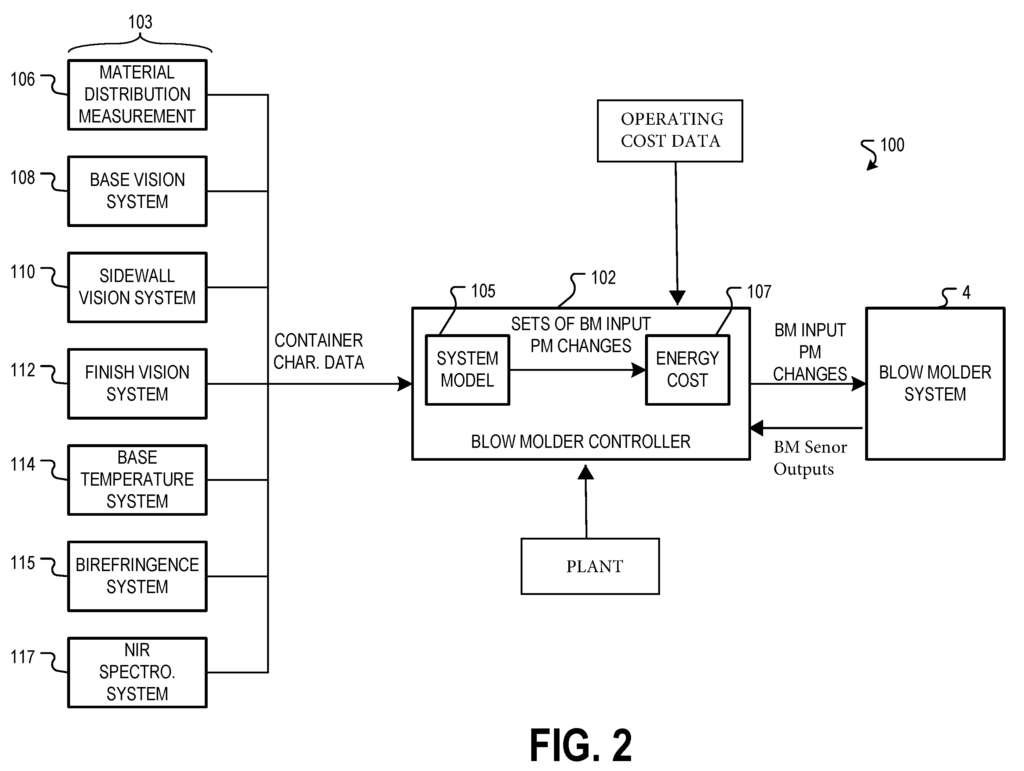
Figure 2 of WO2019152365A1
-
Claim 1 of Main Request (feature number included by the Board)
Is it patentable?
The Opposition Division’s position
The case concerns an appeal by the opponent against the Opposition division’s decision to rejected the opposition. The Division found that document D1 (DE 10 2013 103 543 A1) did not disclose feature 1.7.2 “operating cost data for the blow molder (6), wherein the operating cost data comprises energy costs for operating the blow molder (6)”, and the objective technical problem was defined as providing a blow molder system with optimised operation, which was found to be technical and non-obvious.
The Appellant’s (Opponent’s) arguments
The appellant (opponent) argued that the claim was not novel as the term “energy costs” was not limited to monetary costs of energy but also encompassed energy consumption. Since document D1 disclosed determining the operating mode offering optimal energy consumption, the appellant argued that feature 1.7.2 was already disclosed in document D1.
On inventive step, the appellant argued that “operating cost data” was not technical but purely an economic consideration.
The Board’s analysis
Main Request
The Board interpreted “energy costs” as the monetary costs of energy, such as electricity, heat, and pressurized air for the plant. Thus, the Board identified feature 1.7.2 as the sole distinguishing feature over the disclosure of document D1.
However, the critical issue was whether the technical problem of providing a blow moulding system with optimised operation was solved across essentially the entire scope of the claim. The claim of the main request also encompassed a scenario where energy cost were fixed, and in such a scenario, the energy costs become proportional to the energy consumption of the blow molder.
Since document D1 determines the operating mode offering optimal energy consumption with minimal energy consumption, thus, in a scenario with a fixed energy price, this would be equivalent to minimal energy costs. Thus, the technical effect was not achieved, and the problem had to be reformulated to merely providing an alternative.
The Board then determined that the skilled person in D1 will interchangeably provide parameters based on energy consumption or operating cost data, comprising energy costs as alternatives, in a fixed-price scenario. Thus, it lacked inventive step.
Auxiliary Request
Feature 1.7.2 was amended to additionally include the italicised part as “operating cost data for the blow molder (6), wherein the operating cost data comprises energy costs for operating the blow molder (6) and incremental costs to make changes to the operating parameters of the blow molder (6), wherein the incremental costs are based, at least in part, on the energy costs for operating the blow molder (6)”
In particular, the operating cost data also comprises incremental costs to make changes to the operating parameters of the blow molder, wherein the incremental costs are based, at least in part, on the energy costs for operating the blow molder.
The appellant (Opponent) argued that these additional features were implicitly disclosed in document D1, because any incremental change to an operating parameter, such as a preform temperature increase, will affect energy costs. The Board was not convinced and considered that the operating mode does not require incremental variations of the power consumption of the compressor or the electrical power consumption of the drives. Thus, the feature was not disclosed.
The feature optimizes the operation of the blow molder by taking into account the incremental energy costs of making changes to the operating parameters. Therefore, the subject-matter of the auxiliary request involves an inventive step.
More information
You can read the full decision here: T 1261/24 of May 21, 2026, of the Technical Board of Appeal 3.2.05.