

The application relates to distributed training of a model, such as one used for face or speech recognition. In particular, the model is trained across a distributed reader, trainer and parameter server, as training on a single machine may be a heavy burden as both the training data and the models grow. The distributed trainers and the parameter server perform a “global shuffle” of the training samples across the whole system, and additionally provide a load-balancing that adjusts according to the computing power of each trainer. The examining division refused the application for lack of inventive step. The Board considered that the AI model for face or speech recognition, and that shuffling training samples, applying them across a distributed system, and adjusting computing power for dynamic load balancing, although technical, were well-known general concepts in computing. Therefore, not inventive.
Here are the practical takeaways from the decision: T 1306/25 (Distributed training/BAIDU) of 12 November 2026, Technical Board of Appeal 3.5.06.
Key takeaways
The invention
The invention concerns an apparatus for distributed training of a model, such as one used for face or speech recognition. As deep learning models and the data behind them grew, training them on a single machine became too heavy a burden, so the training process is instead divided into a distributed reader, a distributed trainer and a distributed parameter server that are mutually independent. A reader in the distributed reader acquires a training sample and loads it to a corresponding trainer, which performs model training on that sample to obtain gradient information, and a parameter server updates a parameter of the initial model based on that gradient information to obtain a trained target model. The apparatus further comprises a distributed parameter processor, which sends, receives and aggregates parameters and gradients in the distributed trainer, and a distributed communicator, which performs data interaction on parameters and gradients between the distributed trainer and the distributed parameter server and performs a global shuffle of the training sample in the distributed trainer
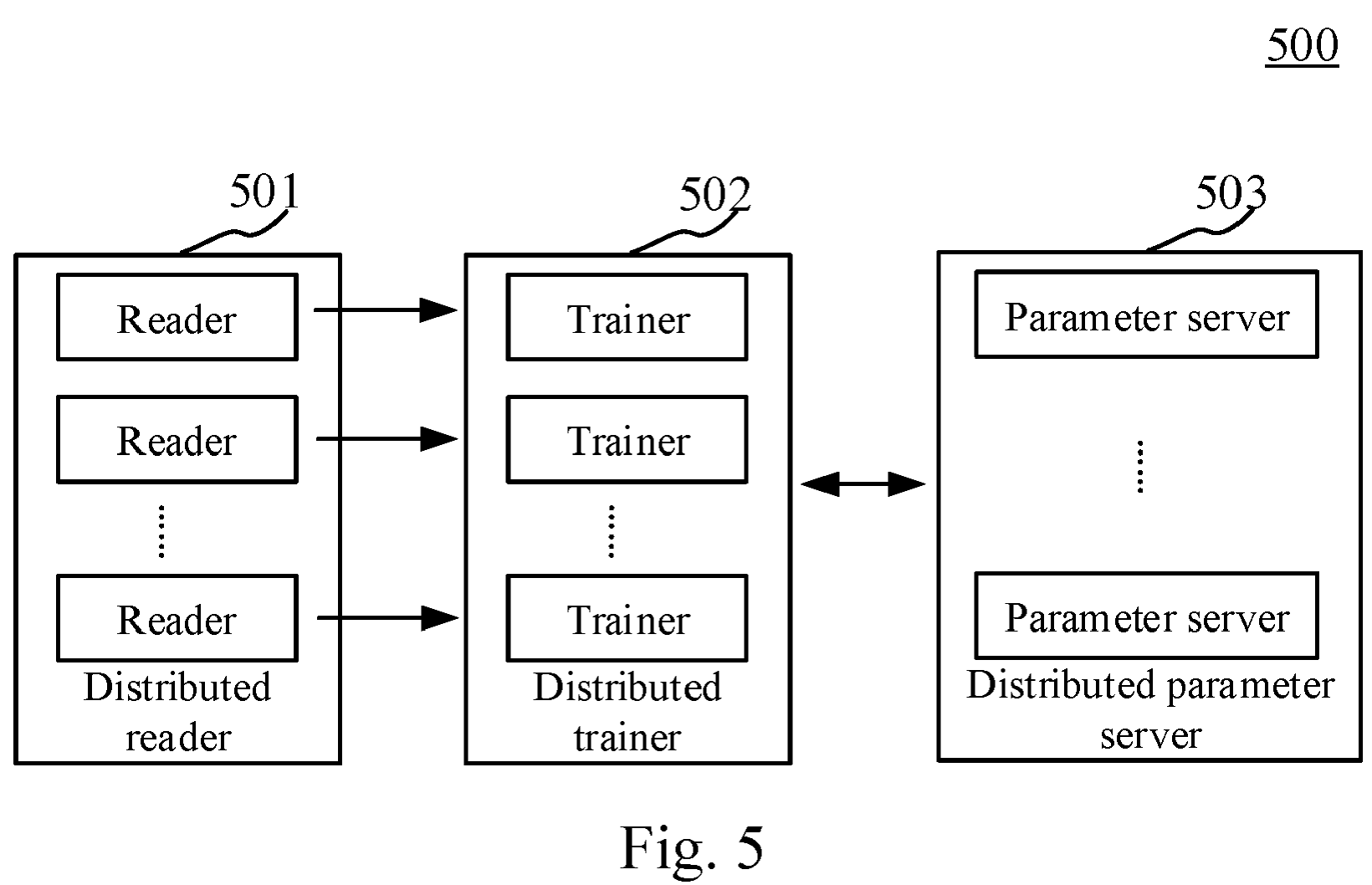
Figure 5 of EP 4 016 398 A1
-
Claim 1 of Auxiliary Request
Is it patentable?
The Examining Division’s position
The examining division refused the application for d lack of inventive step over document D1, an architecture for distributed learning. In particular, it identified three differences from D1: the use of a model for face or speech recognition, the global shuffling, and load balancing feature, and considered each a well-known and obvious measure.
The Applicant’s arguments
The appellant argued that “global shuffle” was clear: data randomization is a well known procedure used to avoid bias induced by the order of the training samples. Furthermore, they also argued that there was no hint in D1 towards global shuffling, since the task randomization discussed in D1 related to task distribution rather than to shuffling training samples, and that the examining division had not provided evidence that randomization was standard practice before the relevant date. On the load balancing feature, it argued that the examining division had conflated a “static task limitation” with “dynamic load balancing”, which it described as a known technical distinction in distributed systems, and noted that load balancing was not universally applied.
The Board’s analysis
The Board interpreted the term “global shuffle” to mean both shuffling data across all trainers and shuffling all data before it is distributed to the trainers.
Fruthermore, the Board agred that the use of a model for face or speech recognition was an obvious use, which the appellant did not contest. As for global shuffling, the Board agreed that randomization was standard practice before the relevant date, noting that the appellant’s own clarity argument relied on that same point, which made the measure obvious for any machine learning training system irrespective of whether D1 contains an explicit hint towards it. The Board also considered it obvious that such randomization would be applied “globally” once the data is distributed between trainers, since randomization is typically applied to the full set of data. On the load balancing feature, the Board found that it does not go beyond the general concept of dynamic load balancing, which is well known and used in any type of distributed computing, and that the feature’s not being universally applied does not mean it is not obvious to use; the skilled person would consider using it in D1 as well. Therefore, the subject-matter lacked inventive step and the patent application was refused.
More information
You can read the full decision here: T 1306/25 (Distributed training/BAIDU) of 12 November 2026, Technical Board of Appeal 3.5.06.