

The application relates to a method of providing a dataset for additive manufacturing. During the buildup of each layer of a 3D-printed metal part, the system collects data, evaluates the layer’s structural quality from it, deletes the data representing poor quality, and overlays a second type of data onto what remains, which can be toggled on or off. The applicant argued that deleting the poor-quality data made the remaining data clearer to examine, allowing detection of defects such as hidden cavities. However, the Board found that deleting this data altogether prevents the subsequent indication and analysis of structural defects, rather than enabling it, and that an arbitrary reduction of information content does not have a technical effect. Furthermore, displaying the resulting dataset was found to be mere presentation of information, and toggling the second type of data on and off produced no technical effect either.
Here are the practical takeaways from the decision: T 1237/24 (Additive manufacturing quality dataset/SIEMENS ENERGY GLOBAL) of 30 July 2026, of the Technical Board of Appeal 3.5.01.
Key takeaways
The invention
The invention concerns a method of providing a dataset for the additive manufacture of a component. During the buildup of each layer, a first type of data, such as optical or image data, microscopical data, CAD data, CAM data, or numerical control data, is collected and used to evaluate the layer’s structural quality. The data representing fractions of insufficient structural quality is then deleted, using an algorithm that captures regions of unsolidified or erroneously solidified powder in the powder bed. A second type of data, suitable to support validation of the as-manufactured structural quality, is then superimposed onto what remains, and this second type of data is toggled on and/or off in the dataset. The resulting dataset is a graphical and/or tomographical 3D dataset of the as-manufactured component.
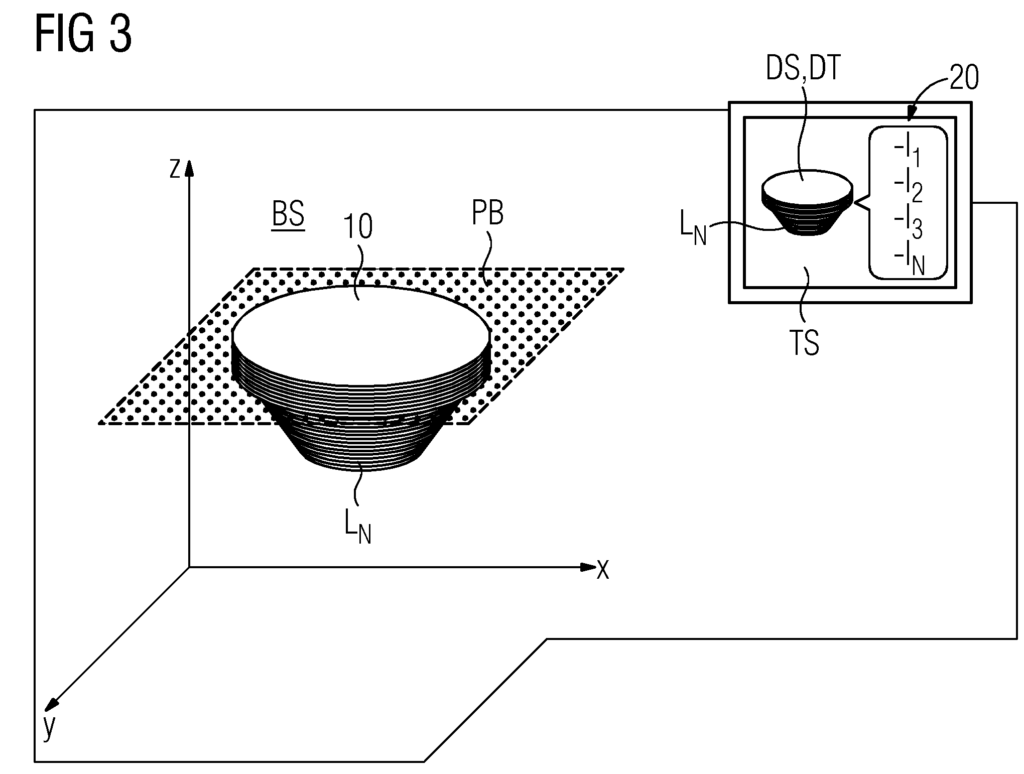
Figure 2 of WO 2018/189301 A1
-
Claim 1 of Main Request
Is it patentable?
The Examining Division’s position
The Examining Division refused the application for lack of inventive step over document D1, which also concerns generating a dataset for a component produced by additive manufacturing. It found that claim 1 differs from D1 in that data representing insufficient structural quality is deleted and the displaying. It was considered that these distinguishing features merely present already-known information in an alternative way, lacking technical character.
The Applicant’s arguments
The applicant argued that the generated dataset in the prior approach was too large to analyze visually, and that deleting the poor-quality data, together with the ability to toggle a second set of data on and off, reduced the amount of data to review and left the remaining data unobstructed, allowing the detection of unwanted cavities.
The applicant further argued that this allowed the dataset to be displayed and analyzed in real time while the manufacturing process was still running, enabling the user to exercise real-time control and prevent failures before they occurred, comparable to the technical effects found in decisions T 643/00 and T 928/03.
The Board’s analysis
The Board agreed that displaying the generated dataset is mere presentation of information, which is not a technical effect. On deleting the poor-quality data, the Board could not see any effect beyond an arbitrary reduction of information content, which does not support an inventive step. The Board rejected the applicant’s argument that this accelerates defect analysis: since the deleted data is precisely what would show a defect, removing it altogether prevents the subsequent indication and analysis of structural defects, rather than enabling it. The Board also noted that although the claim includes an algorithm that captures regions of unsolidified or erroneously solidified powder, its output is never used by the deletion feature or anywhere else in the claim, so the alleged cavity-detection effect was not actually achieved.
The real-time display and control arguments, and the comparison to T 643/00 and T 928/03, likewise relied on effects not derivable from the claim, which gives no detail on how the dataset is presented. Considering the alternative where the second type of data is toggled off, the Board found this merely inserts and then immediately removes data, which is superfluous processing with no technical advantage, a foreseeable disadvantageous modification of D1. Claim 1 of the main request was therefore found to lack an inventive step.
More information
You can read the full decision here: T 1237/24 (Additive manufacturing quality dataset/SIEMENS ENERGY GLOBAL) of 30 July 2026, of Appeal 3.5.01.